
The eBooks we sell are sold as a single-user licence and are intended for the end user only.
The sale of some eBooks are restricted to certain countries. To alert you to such restrictions, please select the country of the billing address of your credit or debit card you wish to use for payment.
For further information see https://www.wildy.com/ebook-formats
Once the order is confirmed an e-mail will be sent to you to allow you to download the eBook. For UK purchases this will be automatic. For purchases outside the UK a member of staff will need to confirm the sale. (Staff are available to do this during normal business hours, Mon-Fri 8:30-17:00 UK time)
All eBooks are supplied firm sale and cannot be returned. If you believe there is a fault with your eBook then contact us on ebooks@wildy.com and we will help in resolving the issue. This does not affect your statutory rights.
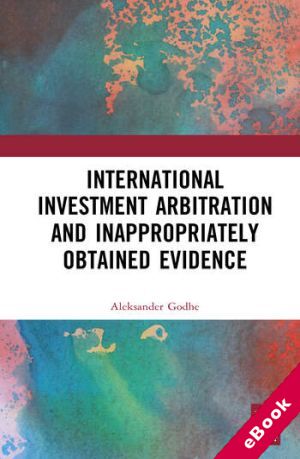
This book provides a comprehensive analysis of inappropriately obtained evidence in international investment arbitration, an increasingly pressing issue given technological advances and evolving notions of impropriety.
Despite the broad procedural discretion of investment tribunals, clear guidance on approaching inappropriately obtained evidence remains lacking, risking inconsistency and unfairness. To address this gap, the book proposes a structured evidentiary test, drawing on doctrinal, empirical and comparative analyses. It examines relevant case law from investment arbitration, international courts and domestic tribunals, alongside key legal principles such as evidentiary discretion and tribunal duties. Beyond theory, the book provides tribunals with a practical framework for approaching inappropriately obtained evidence, including the balancing of probative value with the degree of impropriety in evidence procurement. By situating its analysis within broader trends in investment arbitration, including state conduct and systemic reforms, this work serves as an essential resource for navigating one of the most challenging evidentiary issues.
The book will be of interest to practitioners and researchers in the field of international investment arbitration and beyond.,/p>










