
The eBooks we sell are sold as a single-user licence and are intended for the end user only.
The sale of some eBooks are restricted to certain countries. To alert you to such restrictions, please select the country of the billing address of your credit or debit card you wish to use for payment.
For further information see https://www.wildy.com/ebook-formats
Once the order is confirmed an e-mail will be sent to you to allow you to download the eBook. For UK purchases this will be automatic. For purchases outside the UK a member of staff will need to confirm the sale. (Staff are available to do this during normal business hours, Mon-Fri 8:30-17:00 UK time)
All eBooks are supplied firm sale and cannot be returned. If you believe there is a fault with your eBook then contact us on ebooks@wildy.com and we will help in resolving the issue. This does not affect your statutory rights.
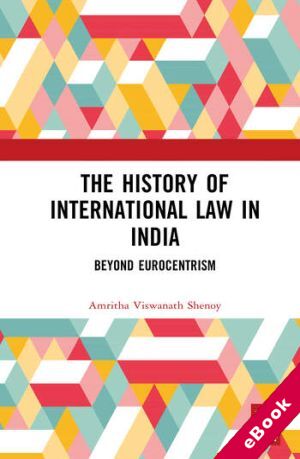
Challenging Eurocentric histories and accounts of international law, this book elicits an alternative history in pre-independent India.
Western scholars trace the genesis of international law to Europe. On the other hand, scholars from the Global South trace the history of international law to different civilisations of the world existing since ancient times. They argue that European narratives are not sufficient to explain the true history of international law. Rather, the history of international law should shed itself of its Eurocentrism and adopt a multi-civilisational perspective, according to which local and national histories can contribute towards a truly global history, and in so doing enhance the legitimacy of international law. Taking up such a perspective, the book traces the history of key elements of international law – such as diplomacy, trade and war – in and to pre-independent India. As Grotius himself acknowledged, in taking his cue from the practice of Asian States whilst arguing for the freedom of the seas, the book thereby elicits the contribution made by India, among other Global South nations, to the evolution and development of international law.
The History of International Law in India is an alternative account of the history of international law and will appeal to scholars and students in the areas of legal history, international law –especially TWAIL – and South Asian Studies.










