
The eBooks we sell are sold as a single-user licence and are intended for the end user only.
The sale of some eBooks are restricted to certain countries. To alert you to such restrictions, please select the country of the billing address of your credit or debit card you wish to use for payment.
For further information see https://www.wildy.com/ebook-formats
Once the order is confirmed an e-mail will be sent to you to allow you to download the eBook. For UK purchases this will be automatic. For purchases outside the UK a member of staff will need to confirm the sale. (Staff are available to do this during normal business hours, Mon-Fri 8:30-17:00 UK time)
All eBooks are supplied firm sale and cannot be returned. If you believe there is a fault with your eBook then contact us on ebooks@wildy.com and we will help in resolving the issue. This does not affect your statutory rights.
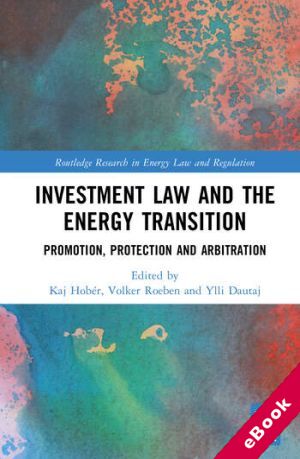
This book covers international investment law and investor-state dispute settlement in the energy transition era.
The Paris Agreement makes it clear that we need a climate-resilient development in order to limit the rise in global average temperature to 1.5℃ pre-industrial levels. International lawyers have caught up to reality and also to understanding the role that the legal framework and legal processes play in causing as well as solving the global climate crisis. Put simply, the energy sector, as well as the overall economy, must become greener. To achieve green transition, foreign direct investments are crucial. With that in mind, this book discusses how economy, environmental policy, and investment protection must work together as an effective global governance tool. This promotes and protects renewable energy investments on the one hand, and aids sustainability on the other. This book underscores key issues in the field and offers an overview of the legal landscape available to achieve the goals set out in the Paris Agreement, which clearly articulates that finance flows should be consistent with a pathway to low greenhouse gas emissions.
This book will be of interest to researchers, practitioners, and policy-makers in the field of investment law, energy law and environmental law, in general, and those operating at the intersection of the mentioned, in particular.










