
The eBooks we sell are sold as a single-user licence and are intended for the end user only.
The sale of some eBooks are restricted to certain countries. To alert you to such restrictions, please select the country of the billing address of your credit or debit card you wish to use for payment.
For further information see https://www.wildy.com/ebook-formats
Once the order is confirmed an e-mail will be sent to you to allow you to download the eBook. For UK purchases this will be automatic. For purchases outside the UK a member of staff will need to confirm the sale. (Staff are available to do this during normal business hours, Mon-Fri 8:30-17:00 UK time)
All eBooks are supplied firm sale and cannot be returned. If you believe there is a fault with your eBook then contact us on ebooks@wildy.com and we will help in resolving the issue. This does not affect your statutory rights.
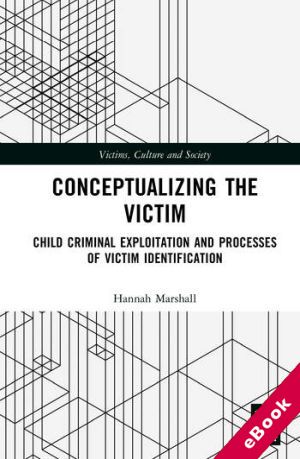
Drawing on empirical research that examines how processes of victim identification unfold in relation to cases of child criminal exploitation in the UK, the book explores four different qualities of the concept ‘victim’. Specifically, the book provides ways of thinking about the concept of ‘victim’ as: incorporeal, in that efforts to convert victim recognition into meaningful impact are often extremely difficult to realise; binary, in that the victim is defined and constructed in opposition to the figure of the offender; relational, in that its emergence is heavily influenced by interactions; and precarious, in that the category ‘victim’ is often time-limited and subject to ongoing scrutiny.
These insights demonstrate that the social construction of victim status is fraught with frustration, resistance, and exclusion. Existing research and advocacy work has often followed the assumption that the solution to this is that more people need better access to the label ‘victim’. But what if there are fundamental flaws within the conceptual category of ‘victim’ itself? Accordingly, this book considers possibilities of moving beyond the category ‘victim’ and finding alternative approaches of acknowledging and responding to harm in meaningful ways.
This book will therefore be of interest to students and scholars of criminology and victimology. It will also be useful resource for professionals in policing, youth justice and victim support.










