
The eBooks we sell are sold as a single-user licence and are intended for the end user only.
The sale of some eBooks are restricted to certain countries. To alert you to such restrictions, please select the country of the billing address of your credit or debit card you wish to use for payment.
For further information see https://www.wildy.com/ebook-formats
Once the order is confirmed an e-mail will be sent to you to allow you to download the eBook. For UK purchases this will be automatic. For purchases outside the UK a member of staff will need to confirm the sale. (Staff are available to do this during normal business hours, Mon-Fri 8:30-17:00 UK time)
All eBooks are supplied firm sale and cannot be returned. If you believe there is a fault with your eBook then contact us on ebooks@wildy.com and we will help in resolving the issue. This does not affect your statutory rights.
Due to a technical issue some ebooks are not available to order.
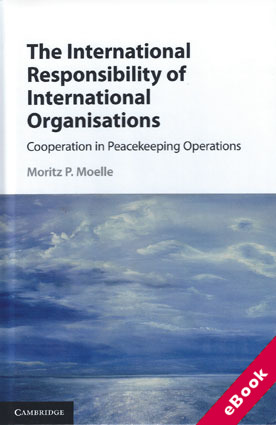
The International Responsibility of International Organisations addresses the joint responsibility of organisations for violations of international law committed during the deployment of peacekeeping operations. More specifically, it inquires if and under which circumstances - in terms of the notion of control - international organisations can be jointly responsible. The author analyses the practice of international organisations (the United Nations, NATO, the European Union, the African Union and the Economic Community of West African States) on an inter-institutional level, as well as in the field in the form of five case studies. The likelihood and distribution of responsibility between international organisations engaged in peacekeeping operations is affected by the different layers of applicable primary norms (Security Council mandates, internal law of the organisations, international humanitarian and human rights law). Although external pressure may contribute to enhancing the effectiveness of holding international organisations jointly responsible, any substantial measures and mechanisms can only be implemented with the participation of states and international organisations.










