
The eBooks we sell are sold as a single-user licence and are intended for the end user only.
The sale of some eBooks are restricted to certain countries. To alert you to such restrictions, please select the country of the billing address of your credit or debit card you wish to use for payment.
For further information see https://www.wildy.com/ebook-formats
Once the order is confirmed an e-mail will be sent to you to allow you to download the eBook. For UK purchases this will be automatic. For purchases outside the UK a member of staff will need to confirm the sale. (Staff are available to do this during normal business hours, Mon-Fri 8:30-17:00 UK time)
All eBooks are supplied firm sale and cannot be returned. If you believe there is a fault with your eBook then contact us on ebooks@wildy.com and we will help in resolving the issue. This does not affect your statutory rights.
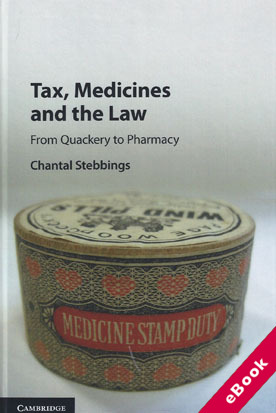
In 1783 a stamp duty was imposed on proprietary or 'quack' medicines. These largely useless but often dangerous remedies were immensely popular.
The tax, which lasted till 1941, was imposed to raise revenue. It failed in its incidental regulatory purpose, had a negative effect in that the stamp was perceived as a guarantee of quality, and a positive effect in encouraging disclosure of the formula.
It promoted the pharmacy profession by recognising chemists and druggists as an occupational group and provoking their unity in opposition, but undermined it by reinforcing their trading character. The legislation imposing the tax was complex, ambiguous and never reformed.
The tax authorities had to administer it, and executive practice came to dominate it. A minor, specialised, low-yield tax is shown to be of real significance in the pharmaceutical context, and of exceptional importance as a model revealing the wider impact of tax law and administration.










