
The eBooks we sell are sold as a single-user licence and are intended for the end user only.
The sale of some eBooks are restricted to certain countries. To alert you to such restrictions, please select the country of the billing address of your credit or debit card you wish to use for payment.
For further information see https://www.wildy.com/ebook-formats
Once the order is confirmed an e-mail will be sent to you to allow you to download the eBook. For UK purchases this will be automatic. For purchases outside the UK a member of staff will need to confirm the sale. (Staff are available to do this during normal business hours, Mon-Fri 8:30-17:00 UK time)
All eBooks are supplied firm sale and cannot be returned. If you believe there is a fault with your eBook then contact us on ebooks@wildy.com and we will help in resolving the issue. This does not affect your statutory rights.
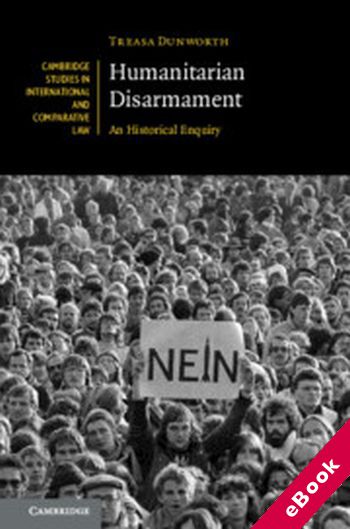
The humanitarian framing of disarmament is not a novel development, but rather represents a re-emergence of a much older and long-standing sensibility of humanitarianism in disarmament. It rejects the 'big bang' theory that presents the Anti-Personnel Landmines Convention 1997, and its successors – the Convention on Cluster Munitions 2008, and the Treaty on the Prohibition of Nuclear Weapons 2017 – as a paradigm shift from an older traditional state-centric approach towards a more progressive humanitarian approach. It shows how humanitarian disarmament has a long and complex history, which includes these treaties.
This book argues that the attempt to locate the birth of humanitarian disarmament in these treaties is part of the attempt to cleanse humanitarian disarmament of politics, presenting humanitarianism as a morally superior discourse in disarmament. However, humanitarianism carries its own blind spots and has its own hegemonic leanings. It may be silencing other potentially more transformative discourses.










