
The eBooks we sell are sold as a single-user licence and are intended for the end user only.
The sale of some eBooks are restricted to certain countries. To alert you to such restrictions, please select the country of the billing address of your credit or debit card you wish to use for payment.
For further information see https://www.wildy.com/ebook-formats
Once the order is confirmed an e-mail will be sent to you to allow you to download the eBook. For UK purchases this will be automatic. For purchases outside the UK a member of staff will need to confirm the sale. (Staff are available to do this during normal business hours, Mon-Fri 8:30-17:00 UK time)
All eBooks are supplied firm sale and cannot be returned. If you believe there is a fault with your eBook then contact us on ebooks@wildy.com and we will help in resolving the issue. This does not affect your statutory rights.
Due to a technical issue some ebooks are not available to order.
Despite bringing prosperity, industrialisation generally leads to increasing levels of pollution which has a detrimental impact on the environment. In response, legislation which seeks to control or prevent such impact has become common.
Similarly, climate change and energy security have become major drivers for the regulatory regimes that have emerged in the energy field. Given the global or regional scope of many environmental problems, international cooperation is often necessary to ensure such legislation is effective.
The EU and the UK have contributed to the development of the environmental and energy law regimes currently in force, spanning across international, transnational and national levels. At the same time, practical responses to environmental and energy problems have largely been the focus of engineers, scientists and other technical experts.
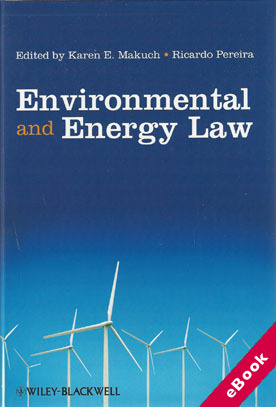
Environmental & Energy Law attempts to bridge the knowledge gap between legal developments designed to achieve environmental and/or energy-related objectives and the practical, scientific and technical considerations applicable to the same environmental problems.
In particular, it attempts to convey a broad range of topical issues in environmental and energy law, from climate and energy regulation, technology innovation and transfer, to pollution control, environmental governance and enforcement. In addition the book outlines key sector specific legal regimes (including water, waste and air quality management), focusing on issues or topics that are particularly relevant to both environmental and energy lawyers, and engineering, science and technology-oriented professionals and students.
In this vein, the book guides the reader on some basic practical applications of the law within scientific, engineering and other practical settings. The book will be useful to all those working or studying in the environmental or energy arena, including law students, legal professionals, engineering and science students and professionals.
By adopting a multi-disciplinary approach to environmental and energy law, the book embraces all readerships and helps to address the often thorny problem of communication between scientists, engineers, lawyers and policy-makers.










