
The eBooks we sell are sold as a single-user licence and are intended for the end user only.
The sale of some eBooks are restricted to certain countries. To alert you to such restrictions, please select the country of the billing address of your credit or debit card you wish to use for payment.
For further information see https://www.wildy.com/ebook-formats
Once the order is confirmed an e-mail will be sent to you to allow you to download the eBook. For UK purchases this will be automatic. For purchases outside the UK a member of staff will need to confirm the sale. (Staff are available to do this during normal business hours, Mon-Fri 8:30-17:00 UK time)
All eBooks are supplied firm sale and cannot be returned. If you believe there is a fault with your eBook then contact us on ebooks@wildy.com and we will help in resolving the issue. This does not affect your statutory rights.
Due to a technical issue some ebooks are not available to order.
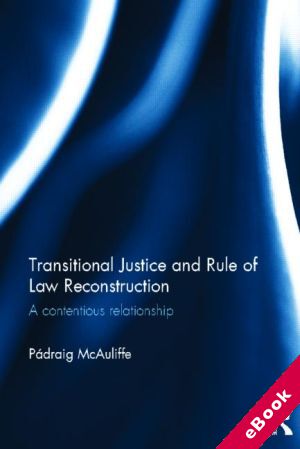
This book examines the interaction of transitional justice and rule of law reconstruction projects in post-conflict societies, the dilemmas it brings and possible solutions. Though the ordinary presumption is that the two processes should be mutually reinforcing and complementary, practice in the last twenty years has demonstrated under-appreciated and under-analysed discontinuities and contradictions in states where both have been attempted.
This book traces the diverging development of both rule of law reconstruction and transitional justice since the end of the Cold War, demonstrating how the domestic formal justice system which is at the centre of rule of law reform has been by-passed by methods which do little to develop national institutions and which can corrode their cultural legitimacy. The book then goes on to examine how transitional trials in international, domestic and mixed/hybridised courts can detract from, or complement, on-going processes of justice sector reform. Finally the book considers the use of alternative justice mechanisms in transition. It examines the dangers and opportunities of circumventing the formal justice system by using measures such as conditional amnesties, truth and reconciliation commissions and traditional or local justice mechanisms which may not have long-term application or analogues in the reforming justice sector.










