
The eBooks we sell are sold as a single-user licence and are intended for the end user only.
The sale of some eBooks are restricted to certain countries. To alert you to such restrictions, please select the country of the billing address of your credit or debit card you wish to use for payment.
For further information see https://www.wildy.com/ebook-formats
Once the order is confirmed an e-mail will be sent to you to allow you to download the eBook. For UK purchases this will be automatic. For purchases outside the UK a member of staff will need to confirm the sale. (Staff are available to do this during normal business hours, Mon-Fri 8:30-17:00 UK time)
All eBooks are supplied firm sale and cannot be returned. If you believe there is a fault with your eBook then contact us on ebooks@wildy.com and we will help in resolving the issue. This does not affect your statutory rights.
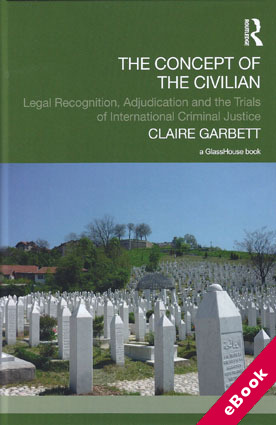
How do international war crimes trials address and redress the civilian victims of armed conflict? The Concept of the Civilian examines how the processes of international criminal justice construct legal recognition of the civilian victims of contemporary armed conflicts.
Drawing on a detailed case-study of the International Criminal Tribunal for the former Yugoslavia (ICTY), this book examines two key issues central to these justice processes. Firstly, how civilians are understood as a social and legal category of persons; and secondly, how legal practices shape victim identities and redress in relation to these persons.
Combining socio-legal concepts and methodologies with insights from transitional justice scholarship, Claire Garbett thus traces the historical emergence of the concept of the civilian, and critically examines how the different stages of legal proceedings produce its conceptual form in distinction from that of combatants.
This book shows that the very notions of ‘civilian’, ‘protection’ and ‘redress’ that underpin current practices of international criminal justice continue to evoke both definitional difficulties and analytic contestation. Accordingly, it remains unclear how the practices of international criminal justice work to address and redress the civilian victims of contemporary armed conflicts.










