
The eBooks we sell are sold as a single-user licence and are intended for the end user only.
The sale of some eBooks are restricted to certain countries. To alert you to such restrictions, please select the country of the billing address of your credit or debit card you wish to use for payment.
For further information see https://www.wildy.com/ebook-formats
Once the order is confirmed an e-mail will be sent to you to allow you to download the eBook. For UK purchases this will be automatic. For purchases outside the UK a member of staff will need to confirm the sale. (Staff are available to do this during normal business hours, Mon-Fri 8:30-17:00 UK time)
All eBooks are supplied firm sale and cannot be returned. If you believe there is a fault with your eBook then contact us on ebooks@wildy.com and we will help in resolving the issue. This does not affect your statutory rights.
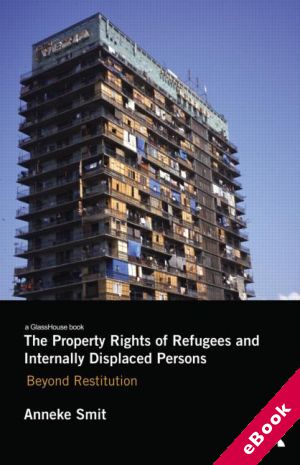
Protecting the Property Rights of Refugees and Internally Displaced Persons: Beyond Restitution pursues a rigorous examination of the various ways in which the protection of housing and property rights can contribute to durable solutions to displacement.
The focus of most of the international community’s recent protection efforts has been on returning displaced persons to their homes following armed conflict. However, this focus on return has come at the expense of considering other possible durable solutions, particularly in cases of protracted displacement.
In this book, Anneke Smit chronicles the failure of the international community’s attempts to promote widespread return through establishing housing and property restitution mechanisms. Drawing on a variety of displacement situations, and referring throughout to international human rights and refugee law, property law and theory, and sociological and anthropological literature on displacement and the meaning of ‘home’, she argues that a housing and property policy which supports integration in the communities where refugees and internally displaced persons find themselves after conflict is likely to represent a more effective and sustainable approach than a singular focus on return.
Protecting the Property Rights of Refugees and Internally Displaced Persons is based on extensive academic research, including fieldwork, as well as more than a decade of the author's practical experience working on displacement issues with government, international organisation and NGO actors. It will be of considerable interest to those with academic and policy interests in the rights of refugees and displaced persons.










