
The eBooks we sell are sold as a single-user licence and are intended for the end user only.
The sale of some eBooks are restricted to certain countries. To alert you to such restrictions, please select the country of the billing address of your credit or debit card you wish to use for payment.
For further information see https://www.wildy.com/ebook-formats
Once the order is confirmed an e-mail will be sent to you to allow you to download the eBook. For UK purchases this will be automatic. For purchases outside the UK a member of staff will need to confirm the sale. (Staff are available to do this during normal business hours, Mon-Fri 8:30-17:00 UK time)
All eBooks are supplied firm sale and cannot be returned. If you believe there is a fault with your eBook then contact us on ebooks@wildy.com and we will help in resolving the issue. This does not affect your statutory rights.
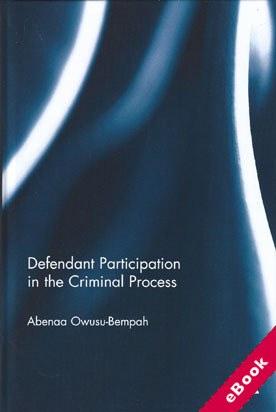
Requirements for the defendant to actively participate in the English criminal process have been increasing in recent years such that the defendant can now be penalised for their non-cooperation. This book explores the ramifications of penalising a defendant’s non-cooperation, particularly its effect on the adversarial system.
The book develops a normative theory of criminal procedure which proposes that the criminal process should operate as a mechanism for calling the state to account for its accusations and request for official condemnation and punishment of the accused. It goes on to examine the limitations placed on the privilege against self-incrimination, adverse inferences drawn from a defendant’s silence, and adverse inferences drawn from defence non-disclosure.
The book shows how by placing participatory requirements on defendants and penalising them for their non-cooperation, a new participatory model of procedure has developed. This model relies on the active participation of the defendant in pursuit of efficient fact-finding, and so, is far removed from England’s history of adversarialism, and shows less of a regard for legitimacy, fairness and respect for defence rights.










