
The eBooks we sell are sold as a single-user licence and are intended for the end user only.
The sale of some eBooks are restricted to certain countries. To alert you to such restrictions, please select the country of the billing address of your credit or debit card you wish to use for payment.
For further information see https://www.wildy.com/ebook-formats
Once the order is confirmed an e-mail will be sent to you to allow you to download the eBook. For UK purchases this will be automatic. For purchases outside the UK a member of staff will need to confirm the sale. (Staff are available to do this during normal business hours, Mon-Fri 8:30-17:00 UK time)
All eBooks are supplied firm sale and cannot be returned. If you believe there is a fault with your eBook then contact us on ebooks@wildy.com and we will help in resolving the issue. This does not affect your statutory rights.
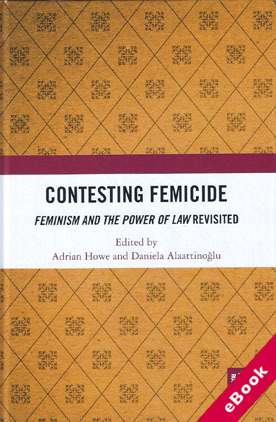
Focusing on femicide, this book provides a contemporary re-evaluation of Carol Smart’s innovative approach to the law question as first outlined in her ground-breaking book, Feminism and the Power of Law (Routledge 1989).
Smart advocated turning to the legal domain not so much for demanding law reforms as construing it as a site on which to contest gender and more particularly, gendered constructions of women’s experiences. Over the last 30 to 40 years, feminist law scholars and activists have launched scathing trans-jurisdictional critiques of the operation of provocation defences in hundreds of femicide cases.
The evidence unearthed by feminist scholars that these defences operate in profoundly sexed ways is unequivocal. Accordingly, femicide cases have become critically important sites for feminist engagement and intervention across numerous jurisdictions.
Exploring an area of criminal law that was not one of Smart’s own focal concerns, this book both honours and extends Smart’s work by approaching femicide as a site of engagement and counter-discourse that calls into question hegemonic representations of gendered relationships.
Femicide cases thus provide a way to continue the endlessly valuable discursive work Smart advocated and practised in other fields of law: both in articulating alternative accounts of gendered relationships and in challenging law’s power to disqualify women’s experiences of violence while privileging men’s feelings and rights.










