
The eBooks we sell are sold as a single-user licence and are intended for the end user only.
The sale of some eBooks are restricted to certain countries. To alert you to such restrictions, please select the country of the billing address of your credit or debit card you wish to use for payment.
For further information see https://www.wildy.com/ebook-formats
Once the order is confirmed an e-mail will be sent to you to allow you to download the eBook. For UK purchases this will be automatic. For purchases outside the UK a member of staff will need to confirm the sale. (Staff are available to do this during normal business hours, Mon-Fri 8:30-17:00 UK time)
All eBooks are supplied firm sale and cannot be returned. If you believe there is a fault with your eBook then contact us on ebooks@wildy.com and we will help in resolving the issue. This does not affect your statutory rights.
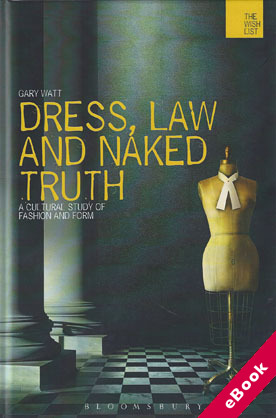
In Dress, Law and Naked Truth, Gary Watt tests the radical thesis that law is dress and dress is law. He argues that they are essentially the same anthropological phenomenon: the life of law is a liminal layer of social ordering and control, in the same way that clothes are Watt traces a loose historical chronology, from the anthropology of dress culture and the emergence of the Indo-European lexicon of dress, through the role of clothes in the social performance of political power since classical antiquity, to the emergence of the 'inner' individual in the Early Modern period and the corresponding suspicion of external appearance.
The final chapter looks at the state of modern law and society, looking especially on three sites of legal anxiety: too much covering up (from hoodies to the veil), too little covering up, and insignia (religious, military etc).
The aim of this book is to open up a broader inter-disciplinary conversation between the fields of material culture and law.There is already an extensive literature on the legal regulation of dress and on clothes as a sign of social ordering.










