
The eBooks we sell are sold as a single-user licence and are intended for the end user only.
The sale of some eBooks are restricted to certain countries. To alert you to such restrictions, please select the country of the billing address of your credit or debit card you wish to use for payment.
For further information see https://www.wildy.com/ebook-formats
Once the order is confirmed an e-mail will be sent to you to allow you to download the eBook. For UK purchases this will be automatic. For purchases outside the UK a member of staff will need to confirm the sale. (Staff are available to do this during normal business hours, Mon-Fri 8:30-17:00 UK time)
All eBooks are supplied firm sale and cannot be returned. If you believe there is a fault with your eBook then contact us on ebooks@wildy.com and we will help in resolving the issue. This does not affect your statutory rights.
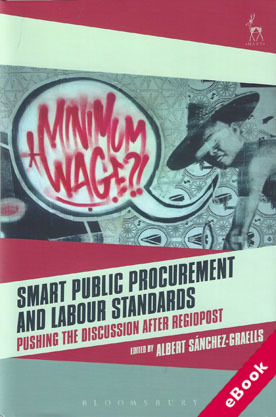
Smart procurement aims to leverage public buying power in pursuit of social, environmental and innovation goals. Socially-oriented smart procurement has been a controversial issue under EU law.
The extent to which the Court of Justice (ECJ) has supported or rather constrained its development has been intensely debated by academics and practitioners alike.
After a slow development of a seemingly permissive approach, the ECJ case law reached an apparent turning point a decade ago in the often criticised judgments in Ruffert and Laval, which left a number of open questions. The recent Bundesdruckerei and RegioPost Judgments have furthered the ECJ case law on socially-oriented smart procurement and aimed to clarify the limits within which Member State can use it to enforce labour standards.
This case law opens up additional possibilities, but it also creates legal uncertainty concerning the interaction of the EU rules on the posting of workers, public procurement and fundamental internal market freedoms. These developments are magnified by the reform of the EU public procurement rules in 2014.
This book assesses the limits that the revised EU rules and the new ECJ case law impose on socially-oriented smart procurement and, more generally, critically reflects on potential future developments in this area of intersection of several strands of EU economic law.










