
The eBooks we sell are sold as a single-user licence and are intended for the end user only.
The sale of some eBooks are restricted to certain countries. To alert you to such restrictions, please select the country of the billing address of your credit or debit card you wish to use for payment.
For further information see https://www.wildy.com/ebook-formats
Once the order is confirmed an e-mail will be sent to you to allow you to download the eBook. For UK purchases this will be automatic. For purchases outside the UK a member of staff will need to confirm the sale. (Staff are available to do this during normal business hours, Mon-Fri 8:30-17:00 UK time)
All eBooks are supplied firm sale and cannot be returned. If you believe there is a fault with your eBook then contact us on ebooks@wildy.com and we will help in resolving the issue. This does not affect your statutory rights.
How do ordinary people access justice?
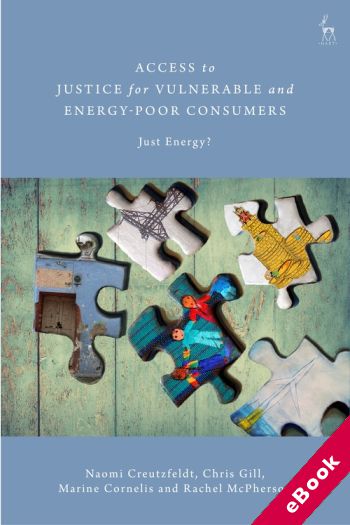
This book offers a novel socio-legal approach to access to justice, alternative dispute resolution, vulnerability and energy poverty. It poses an access to justice challenge and rethinks it through a lens that accommodates all affected people, especially those who are currently falling through the system. It raises broader questions about alternative dispute resolution, the need for reform to include more collective approaches, a stronger recognition of the needs of vulnerable people, and a stronger emphasis on delivering social justice. The authors use energy poverty as a site of vulnerability and examine the barriers to justice facing this excluded group.
The book assembles the findings of an interdisciplinary research project studying access to justice and its barriers in the UK, Italy, France, Bulgaria and Spain (Catalonia). In-depth interviews with regulators, ombuds, energy companies, third-sector organisations and vulnerable people provide a rich dataset through which to understand the phenomenon.
The book provides theoretical and empirical insights which shed new light on these issues and sets out new directions of inquiry for research, policy and practice. It will be of interest to researchers, students and policymakers working on access to justice, consumer vulnerability, energy poverty, and the complex intersection between these fields.
The book includes contributions by Cosmo Graham (UK), Sarah Supino and Benedetta Voltaggio (Italy), Marine Cornelis (France), Anais Varo and Enric Bartlett (Catalonia) and Teodora Peneva (Bulgaria).











