
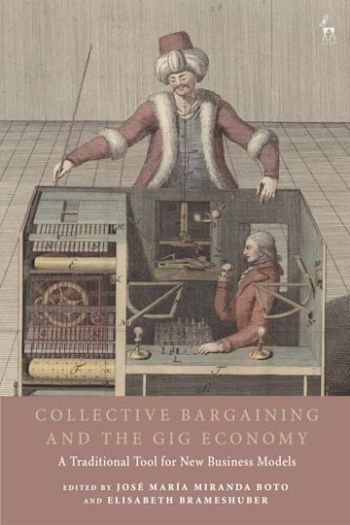
Despite the variety of situations covered by the term “gig economy”, collective agreements for employees and non-employees are being concluded in various countries, either at company or at branch level. Offline workers such as riders, food deliverers, drivers or providers of cleaning services are slowly gaining access to the series of negotiated rights that, in the past, were only available to employees.
The chapters analyse recent high-profile decisions including Uber in France's Court de Cassation, Glovo in the Spanish Supreme Court, and Uber in the UK Supreme Court. They evaluate the bargaining agents in different Member States of the EU, to determine whether established actors are participating in the dynamics of the gig economy or if they are being substituted, totally or partially, by new agents. Interesting best practices are drawn from the comparison, also as regards the contents of collective bargaining, raising awareness in those countries that are being left behind in the dynamics of the gig economy.
The book collects the results of the COGENS (VS/2019/0084) research project, funded by the European Union, that gathered scholars and stakeholders from 17 countries. It will be an invaluable resource for scholars, trade unionists and policy makers.










