The eBooks we sell are sold as a single-user licence and are intended for the end user only.
The sale of some eBooks are restricted to certain countries. To alert you to such restrictions, please select the country of the billing address of your credit or debit card you wish to use for payment.
For further information see https://www.wildy.com/ebook-formats
Once the order is confirmed an e-mail will be sent to you to allow you to download the eBook. For UK purchases this will be automatic. For purchases outside the UK a member of staff will need to confirm the sale. (Staff are available to do this during normal business hours, Mon-Fri 8:30-17:00 UK time)
All eBooks are supplied firm sale and cannot be returned. If you believe there is a fault with your eBook then contact us on ebooks@wildy.com and we will help in resolving the issue. This does not affect your statutory rights.
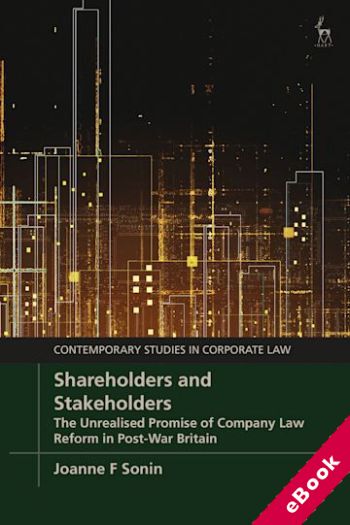
This book explores the evolution of the shareholder in post-war Britain within the context of changing legal, political, economic, and social conditions. It examines how the post-war transformation of the shareholder body influenced relationships amongst stakeholders, impacting corporate behaviour and the legal and political efforts to govern industry and financial markets.
The book addresses a number of themes, including: 1) how the movements for democratisation influenced the treatment of shareholder interests and calls for stakeholder representation; 2) how the rhetoric of change created a narrative that deflected from the lack of systemic legal reforms and protected the status quo; 3) how, in the post-war consensus environment, political positions on equity ownership de-radicalised, which proved unsustainable with increasing polarisation and industrial unrest; and 4) how the institutionalisation of the post-war shareholder body had profound effects on industry, the financial markets, and the economy.
With these themes as a foundation, the evolutionary arc of the post-war shareholder is examined, focusing on developments that influenced the treatment and perception of shareholder and stakeholder interests, including nationalisations, shareholder democracy, corporate purpose, and industrial democracy.
The book further considers how these post-war changes contribute to the post-1979 legal treatment of shareholder and stakeholder interests, including subsequent changes to the Companies Act and the development of corporate governance codes. Parallels to the contemporary trends of stakeholder capitalism, corporate purpose, and ESG are drawn.
The historical analysis of the post-war shareholder provides a framework for considering current questions on shareholder primacy and the demands for systemic legal reforms. These missed opportunities for meaningful changes to the treatment of shareholder interests in UK company law serve as useful precedents for evaluating subsequent periods.