
The eBooks we sell are sold as a single-user licence and are intended for the end user only.
The sale of some eBooks are restricted to certain countries. To alert you to such restrictions, please select the country of the billing address of your credit or debit card you wish to use for payment.
For further information see https://www.wildy.com/ebook-formats
Once the order is confirmed an e-mail will be sent to you to allow you to download the eBook. For UK purchases this will be automatic. For purchases outside the UK a member of staff will need to confirm the sale. (Staff are available to do this during normal business hours, Mon-Fri 8:30-17:00 UK time)
All eBooks are supplied firm sale and cannot be returned. If you believe there is a fault with your eBook then contact us on ebooks@wildy.com and we will help in resolving the issue. This does not affect your statutory rights.
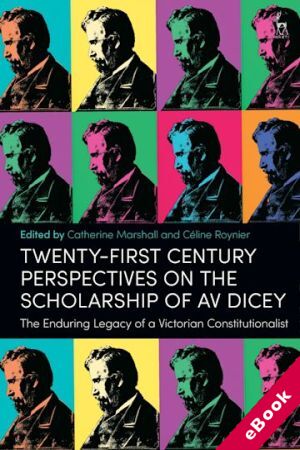
This book reassesses A.V. Dicey's legacy in political and legal thought through the reflections of leading scholars who consider his importance not only in today's British constitutional and legal culture but also in other foreign constitutional cultures.
Every student in law and in politics, every law faculty and most legal practitioners s in the world are aware of who Albert Venn Dicey (1835-1922) was and what he wrote. Yet, this fame does not mean that Dicey's legacy is not controversial and debated in the present world. This book considers why Dicey's late Victorian constitutional and political thinking is still alive. In spite of all the transformations that have taken place in public law in the UK in the last hundred years, the book argues that Dicey managed to grasp and to crystalise something of the British political identity and culture. Hence the long-lasting fire-power of his constitutional and political thinking.
The book also considers that there is something even more prescient in Dicey's writings, for the UK but also for countries that have adopted his understanding of the rule of law and/or of parliamentary government. Dicey identified one of the most fundamental political issues at stake: the nature of the relationship between public law and democracy. The book looks closely at the alliance between public law and democratic spirit. This alliance needs to be reassessed from a legal, historical and comparative perspective. This edited collection, gathering authors from different countries, from various legal systems and from diverse backgrounds, tackles this task.










