
The eBooks we sell are sold as a single-user licence and are intended for the end user only.
The sale of some eBooks are restricted to certain countries. To alert you to such restrictions, please select the country of the billing address of your credit or debit card you wish to use for payment.
For further information see https://www.wildy.com/ebook-formats
Once the order is confirmed an e-mail will be sent to you to allow you to download the eBook. For UK purchases this will be automatic. For purchases outside the UK a member of staff will need to confirm the sale. (Staff are available to do this during normal business hours, Mon-Fri 8:30-17:00 UK time)
All eBooks are supplied firm sale and cannot be returned. If you believe there is a fault with your eBook then contact us on ebooks@wildy.com and we will help in resolving the issue. This does not affect your statutory rights.
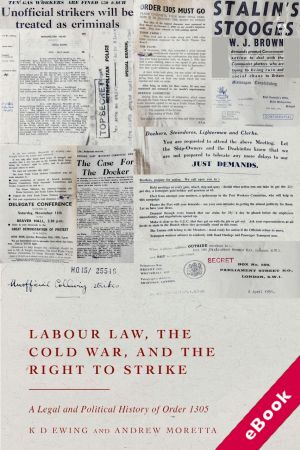
This book examines the origins, deployment, and legacy of Order 1305, a measure introduced in 1940 to make it a criminal offence to take part in a strike.
Surprisingly, the prohibition on the right to strike was retained by the Attlee administration after the Second World War, and was transformed to become a weapon of government during the Cold War to deal with what were wrongly claimed by ministers to be Communist-inspired strikes engineered for subversive purposes.
In a deep analysis of Order 1305, the authors provide a reassessment of the role of the State in industrial relations. Challenging much contemporary learning in labour law, the book is informed by a very detailed engagement with Cabinet and ministerial papers, which highlight the contradictions on the part of government in simultaneously promoting and containing trade union power. These sources also highlight the extent to which trade unions both relied on and were co-opted by the State.
The main focus of the book, however, is the role of Order 1305 in the control of trade union activists. Allegations of Communist-inspired strikes and the role of the criminal law provided an important function in post-war industrial relations for MI5 and Special Branch. Material unearthed at the National Archives demonstrates unequivocally not only that trade unions were deeply penetrated, but also that trade union activists were the subject of extensive surveillance, as the authors fully reveal.










