The eBooks we sell are sold as a single-user licence and are intended for the end user only.
The sale of some eBooks are restricted to certain countries. To alert you to such restrictions, please select the country of the billing address of your credit or debit card you wish to use for payment.
For further information see https://www.wildy.com/ebook-formats
Once the order is confirmed an e-mail will be sent to you to allow you to download the eBook. For UK purchases this will be automatic. For purchases outside the UK a member of staff will need to confirm the sale. (Staff are available to do this during normal business hours, Mon-Fri 8:30-17:00 UK time)
All eBooks are supplied firm sale and cannot be returned. If you believe there is a fault with your eBook then contact us on ebooks@wildy.com and we will help in resolving the issue. This does not affect your statutory rights.
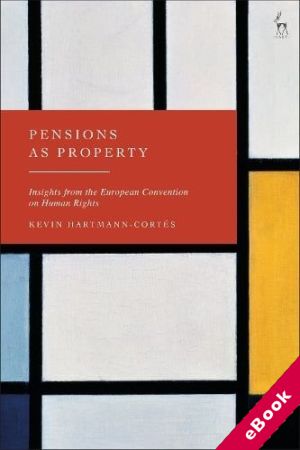
This book explores the impact of the European Convention on Human Rights (ECHR) when defining and protecting pension entitlements as property rights.
The sustainability of pension systems in Europe is threatened by mounting public debt and demographic shifts. In recent decades, governments have addressed these challenges by implementing reforms to balance financial stability and guarantee adequate retirement benefits. Many of these reforms have faced legal challenges from activists and lawyers in domestic courts, based on ‘stand-still’ and ‘non-retrogression’ constitutional principles. However, Article 1 of Protocol No. 1 of the ECHR offers an alternative approach that protects social security entitlements, including pensions, as private property, deserving of protection against unjustified state interference.
This book explores the historical legal rationale employed by the Court to establish social security entitlements as private property. It further examines how the Court has assessed reforms through a proportionality assessment that weights public interests against individual rights. This analysis distils key principles such as reasonableness, non-discrimination, and fair distribution of burdens that can guide policymakers towards responsible, rights-compliant reform.
Hartmann-Cortés prompts critical inquiry into an often-overlooked framework that will be of interest to policymakers, legal scholars, and anyone engaged in debates at the intersection of pension law, property rights, and social welfare law.