
The eBooks we sell are sold as a single-user licence and are intended for the end user only.
The sale of some eBooks are restricted to certain countries. To alert you to such restrictions, please select the country of the billing address of your credit or debit card you wish to use for payment.
For further information see https://www.wildy.com/ebook-formats
Once the order is confirmed an e-mail will be sent to you to allow you to download the eBook. For UK purchases this will be automatic. For purchases outside the UK a member of staff will need to confirm the sale. (Staff are available to do this during normal business hours, Mon-Fri 8:30-17:00 UK time)
All eBooks are supplied firm sale and cannot be returned. If you believe there is a fault with your eBook then contact us on ebooks@wildy.com and we will help in resolving the issue. This does not affect your statutory rights.
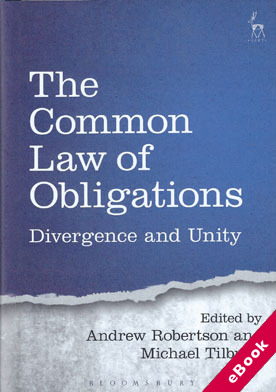
The development of the law of obligations across the common law world has been, and continues to be, a story of unity and divergence. Its common origins continue to exert a powerful stabilising influence, carried forward by a methodology that places heavy weight on the historical foundations of legal principles.
Divergence is, however, produced by numerous factors, including national and international human rights instruments, local statutory regimes, civil law influences, regional harmonisation, local circumstances and values and different political and legal cultures.
The essays in this collection explore the forces that produce divergence, the countervailing forces that generate cohesion and consistency in the common law of obligations, and the influence that the major common law jurisdictions continue to exert over one another in this area of law.
The chapters in this book were originally presented at the Seventh Biennial Conference on the Law of Obligations held in Hong Kong in July 2014. A second collection, entitled Divergences in Private Law (ISBN: 9781782256601), will focus on particular departures from the common law mainstream, the causes and effects of those deviations, and the extent to which they undermine the idea of the common law as a single, transnational body of law.










