
The eBooks we sell are sold as a single-user licence and are intended for the end user only.
The sale of some eBooks are restricted to certain countries. To alert you to such restrictions, please select the country of the billing address of your credit or debit card you wish to use for payment.
For further information see https://www.wildy.com/ebook-formats
Once the order is confirmed an e-mail will be sent to you to allow you to download the eBook. For UK purchases this will be automatic. For purchases outside the UK a member of staff will need to confirm the sale. (Staff are available to do this during normal business hours, Mon-Fri 8:30-17:00 UK time)
All eBooks are supplied firm sale and cannot be returned. If you believe there is a fault with your eBook then contact us on ebooks@wildy.com and we will help in resolving the issue. This does not affect your statutory rights.
Due to a technical issue some ebooks are not available to order.
Marked by the establishment of ISDA in 1985, derivatives have become an indispensable, integral and deeply embedded part of the international financial markets. The new global regulatory framework instituted following the 2008 financial crisis was accompanied by a series of operational, commercial and documentation changes, which has made the derivatives markets stronger, safer and more resilient. However, a deeper and more robust product and regulatory understanding of the derivatives market is more important than ever.
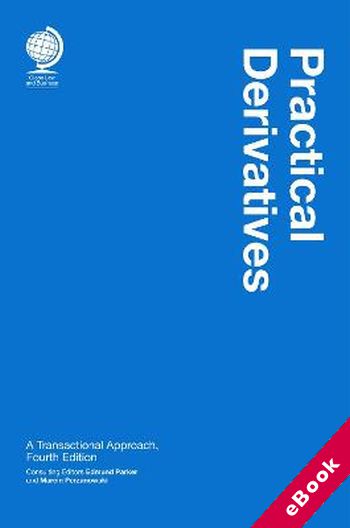
This fourth edition of Practical Derivatives: A Transactional Approach features a number of new chapters analysing the latest trends in the following areas: the rise of derivatives referencing cryptocurrencies and other digital assets, and the emerging regulatory framework on both sides of the Atlantic; the slow but steady move to assets meeting the Environmental, Social and Governance (ESG) criteria in the area of derivatives and structured products; the completion of the regulatory framework for cleared and OTC derivatives; the development of non-English/New York law derivatives documentation; and the emergence of new structures in the securities finance world. It also includes updated chapters explaining how derivatives are used in the practical context, how the documentation works and any pitfalls for the unwary.
It provides real-life tips for the application and negotiation of transactions referencing:
With contributions from leading law firms, investment firms and academics, this accessible book takes a transactional approach and features coverage of product innovations. Whether you are at a bank, asset manager, pension fund, insurance company or other financial institution; from a company or organisation looking to invest or manage your risk; or involved in providing advisory services to these entities, this title will provide you with practical tools for using derivatives in your business.










