
The eBooks we sell are sold as a single-user licence and are intended for the end user only.
The sale of some eBooks are restricted to certain countries. To alert you to such restrictions, please select the country of the billing address of your credit or debit card you wish to use for payment.
For further information see https://www.wildy.com/ebook-formats
Once the order is confirmed an e-mail will be sent to you to allow you to download the eBook. For UK purchases this will be automatic. For purchases outside the UK a member of staff will need to confirm the sale. (Staff are available to do this during normal business hours, Mon-Fri 8:30-17:00 UK time)
All eBooks are supplied firm sale and cannot be returned. If you believe there is a fault with your eBook then contact us on ebooks@wildy.com and we will help in resolving the issue. This does not affect your statutory rights.
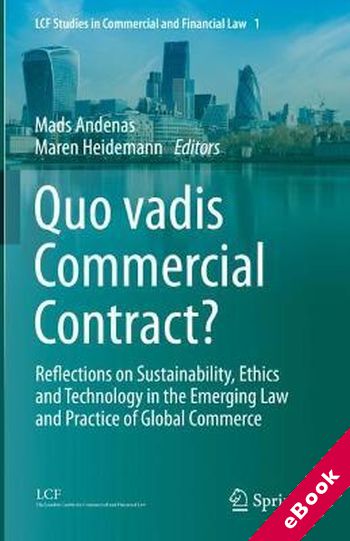
This proceedings volume combines chapters derived from papers presented at the 4th and 5th Annual Conferences on the Future of the Commercial Contract in Scholarship and Law Reform.
This ongoing research project brings together scholars from all over the world at an annual international conference in London. The book focusses on technology in commercial contract law as well as on sustainability in commercial contracts. The latter theme was inspired by the United Nations' climate conference that was to take place in Glasgow in the United Kingdom that same year. The book combines topical current issues in commercial contract law and practice organized in three parts. The first part contains contributions to the area of law and technology. The second part of the book expands on aspects of sustainability understood as environmental reasonableness in the context of commercial contracts. The third part includes several chapters on the topics of supervening events and contractual ethics.
This book is therefore part of a coherent line of contributions to the furthering of modern contract theory. The choice of topics is closely following current issues of legal policy and contract practice.










