
The eBooks we sell are sold as a single-user licence and are intended for the end user only.
The sale of some eBooks are restricted to certain countries. To alert you to such restrictions, please select the country of the billing address of your credit or debit card you wish to use for payment.
For further information see https://www.wildy.com/ebook-formats
Once the order is confirmed an e-mail will be sent to you to allow you to download the eBook. For UK purchases this will be automatic. For purchases outside the UK a member of staff will need to confirm the sale. (Staff are available to do this during normal business hours, Mon-Fri 8:30-17:00 UK time)
All eBooks are supplied firm sale and cannot be returned. If you believe there is a fault with your eBook then contact us on ebooks@wildy.com and we will help in resolving the issue. This does not affect your statutory rights.
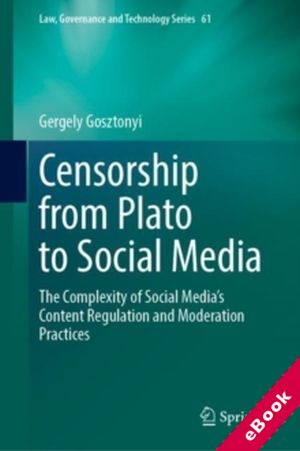
In many countries, censorship, blocking of internet access and internet content for political purposes are still part of everyday life.
Will filtering, blocking, and hacking replace scissors and black ink?
This book argues that only a broader understanding of censorship can effectively protect freedom of expression.For centuries, church and state controlled the content available to the public through political, moral and religious censorship.
As technology evolved, the legal and political tools were refined, but the classic censorship system continued until the end of the 20th century. However, the myth of total freedom of communication and a law-free space that had been expected with the advent of the internet was soon challenged. The new rulers of the digital world, tech companies, emerged and gained enormous power over free speech and content management.
All this happened alongside cautious regulation attempts on the part of various states, either by granting platforms near-total immunity (US) or by setting up new rules that were not fully developed (EU). China has established the Great Firewall and the Golden Shield as a third way. In the book, particular attention is paid to developments since the 2010s, when Internet-related problems began to multiply.
The state's solutions have mostly pointed in one direction: towards greater control of platforms and the content they host. Similarities can be found in the US debates, the Chinese and Russian positions on internet sovereignty, and the new European digital regulations (DSA-DMA).
This book addresses them all. This book will be of interest to anyone who wants to understand the complexities of social media's content regulation and moderation practices. It makes a valuable contribution to the field of freedom of expression and the internet, showing that, with different kinds of censorship, this essentially free form of communication has come - almost by default - under legal regulation and the original freedom may have been lost in too many countries in recent years.










