
The eBooks we sell are sold as a single-user licence and are intended for the end user only.
The sale of some eBooks are restricted to certain countries. To alert you to such restrictions, please select the country of the billing address of your credit or debit card you wish to use for payment.
For further information see https://www.wildy.com/ebook-formats
Once the order is confirmed an e-mail will be sent to you to allow you to download the eBook. For UK purchases this will be automatic. For purchases outside the UK a member of staff will need to confirm the sale. (Staff are available to do this during normal business hours, Mon-Fri 8:30-17:00 UK time)
All eBooks are supplied firm sale and cannot be returned. If you believe there is a fault with your eBook then contact us on ebooks@wildy.com and we will help in resolving the issue. This does not affect your statutory rights.
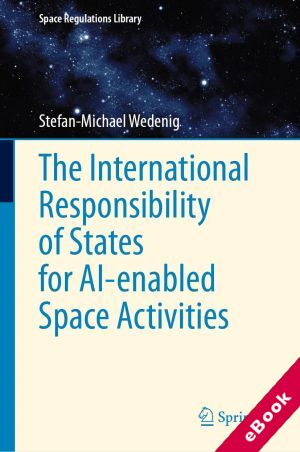
Artificial Intelligence (AI) has permeated our every-day lives. What once was solely a human task, has now been taken over by AI. May it be credit card approvals, customer support, financial transactions, medical imaging or software development, there is AI working behind the scenes.
Outer space, historically always amongst the most developed domains, has not remained untouched for long and space applications have started to increasingly rely on AI. However, this increase in use also leads to a myriad of legal issues, particularly the issue of responsibility and liability under Article VI and Article VII of the Outer Space Treaty and the Liability Convention. Our legal norms, may they be domestic or international in nature, are ultimately built around human behaviour and when applied to AI might not function. Should damage caused by an AI-enabled space object arise, it proves difficult to assess the responsibility of the appropriate State party under Article VI of the Outer Space Treaty, or the liability of the launching State.
While legal literature is primarily concerned with domestic legal issues arising from the use of AI, an in-depth analysis concerning State responsibility and liability for AI-enabled space activities is absent. Space legal literature strongly favours a view advocating for the creation of new “hard law” in form of new binding legal instruments, or the amendment of existing law. Suggestions de lege ferenda are often relied on by authors.
Given the inherent difficulty in creating new law, or amend existing legal instruments, this book proposes to look towards the lex lata and argues that the existing legal norms of State responsibility, State liability and treaty law are sufficient to govern the responsibility of States for their AI-enabled apace activities. The present research looks at these issues from a public international law perspective and proposes a solution within the lex lata.










