
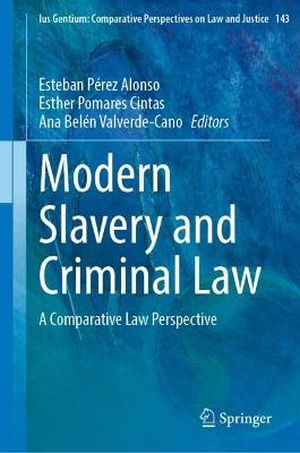
This seminal volume provides a rigorous doctrinal analysis of contemporary slavery through the lens of criminal law and legal dogmatics. It addresses the modern paradox of universal prohibition coexisting with thriving exploitation, offering a robust instrument for law interpretation in both domestic and international courts.
The treatise is organized into four sections. Section I establishes conceptual foundations, diagnosing slavery as an organic product of structural vulnerability within the global neoliberal model rather than a historical anomaly. It further provides a profound constitutionalist perspective on human dignity, a concept essential for a comprehensive understanding of slavery.
Section II maps international standards, tracing the evolution of Article 4 of the ECHR and ILO benchmarks. It elucidates the critical shift from legal ownership to the de facto exercise of powers attaching to ownership, maintaining the severity threshold required to distinguish human rights violations from mere labour malpractice.
A cornerstone of the work is the Anti-Slavery Model Legislation (The Guide to Domestic Legislation) in Section III. This template defines and provides penal frameworks for ten stand-alone forms of exploitation, including slavery, servitude, and forced labour. This section also offers comparative analyses of European and South American legal landscapes.
Section IV addresses institutions of heightened criminal relevance, including the non-punishment provision for victims, complexities in global supply chains, and the challenges of “borderless” criminal jurisdiction. It tackles corporate “ubiquity” and “forum shopping,” proposing models to ensure accountability in fragmented productive networks.
By assembling preeminent legal scholars and practitioners, this book transcends sociological description to provide the dogmatic precision required to narrow the space of impunity. It serves as an indispensable resource for understanding how diverse jurisdictions regulate the most heinous affronts to human freedom and legal personality.











