
Wildy Logo
(020) 7242 5778
enquiries@wildy.com

Book of the Month

Cover of McMeel on the Construction of Contracts: Interpretation, Implication and Rectification

McMeel on the Construction of Contracts: Interpretation, Implication and Rectification

Price: £225.00

Land Registration Manual
4th ed


 Ash Jones


Welcome to Wildys

Watch


Judicial Cooperation in Commercial Litigation 3rd ed (The British Cross-Border Financial Centre World)


 Ian Kawaley, David Doyle, Shade Subair Williams


Offers for Newly Called Barristers & Students

Special Discounts for Newly Called & Students

Read More ...


Secondhand & Out of Print

Browse Secondhand Online

Read More...


2025-6 Christmas and New Year Closing

We are now closed for the Christmas and New Year period, returning on Monday 5th January 2026. Orders placed during this time will be processed upon our return on 5th January.

Hide this message

Sorry. Can't find the title you are looking for.

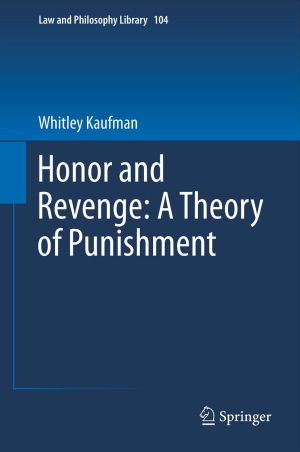
Honor and Revenge: A Theory of Punishment


ISBN13: 9789400748446
Published: August 2012
Publisher: Springer-Verlag
Country of Publication: Netherlands
Format: Hardcover
Price: £109.99


Despatched in 10 to 12 days.

This book addresses the problem of justifying the institution of criminal punishment. It examines the “paradox of retribution”: the fact that we cannot seem to reject the intuition that punishment is morally required, and yet we cannot (even after two thousand years of philosophical debate) find a morally legitimate basis for inflicting harm on wrongdoers.

The book comes at a time when a new “abolitionist” movement has arisen, a movement that argues that we should give up the search for justification and accept that punishment is morally unjustifiable and should be discontinued immediately.

This book, however, proposes a new approach to the retributive theory of punishment, arguing that it should be understood in its traditional formulation that has been long forgotten or dismissed: that punishment is essentially a defense of the honor of the victim. Properly understood, this can give us the possibility of a legitimate moral justification for the institution of punishment.









