Wildy Logo
(020) 7242 5778
enquiries@wildy.com

Book of the Month

Cover of 4 Stone Buildings on Liquidators

4 Stone Buildings on Liquidators

Edited by: Andrew de Mestre KC
Price: £289.00

Planning Law:
A Practitioner's
Handbook 2nd ed


 William Webster, Robert Weatherley


Welcome to Wildys

Watch


Corporate Insolvency Practice:
Litigation, Procedure
and Precedents 3rd ed


 Mark Watson-Gandy


Offers for Newly Called Barristers & Students

Special Discounts for Newly Called & Students

Read More ...


Secondhand & Out of Print

Browse Secondhand Online

Read More...


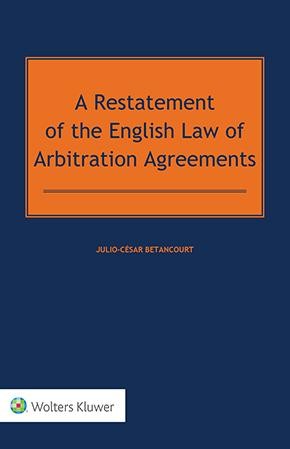
A Restatement of the English Law of Arbitration Agreements


ISBN13: 9789403527079
To be Published: November 2026
Publisher: Kluwer Law International
Country of Publication: Netherlands
Format: Hardback
Price: £155.00


A Restatement of the English Law of Arbitration Agreements is the first comprehensive account of the legal treatment of arbitration agreements governed by English law. It complements the existing statutory and common law framework by setting out the rules and principles derived from legislation and case law in a systematic form. The restatement is accompanied by explanatory notes that provide guidance on the interpretation and application of its provisions.

Structured around the life cycle of an English arbitration agreement, the restatement presents an accessible yet authoritative exposition of the law in thirty-six provisions covering matters ranging from formation to discharge. The provisions deal with the most relevant aspects of arbitration agreements and are grouped under the following headings:

  • general principles and law applicable to the arbitration agreement;
  • validity, illegality, arbitrability and direct effects of an arbitration agreement;
  • material scope, terms, interpretation, incorporation by reference, multi-tiered clauses and other preconditions;
  • arbitration agreements and jurisdiction vested in courts and arbitral tribunals;
  • performance of an arbitration agreement, breach, and remedies available to the non-breaching party; and discharge.

The restatement was drafted with the assistance of an advisory board composed of leading arbitration practitioners and academics. They reviewed the restatement’s provisions and suggested improvements to their content and formulation so as to reflect the law as it currently stands. While the provisions have benefited from that process of scrutiny and refinement, the explanatory notes remain the author’s own commentary and analysis.

By examining the interaction between English contract law, English arbitration law, and the New York Convention, the restatement offers a comprehensive and fully referenced account of the English law of arbitration agreements in the context of international commercial arbitration. It will serve as a clear and reliable guide for arbitration practitioners, judges entertaining arbitration-related applications, academics, and postgraduate students.

Julio César Betancourt is a Lead Tutor in International Dispute Resolution and Arbitration at BPP University's Law School. He was formerly Head of Research and Academic Affairs at the Chartered Institute of Arbitrators and a Junior Academic Visitor at the University of Oxford’s Commercial Law Centre. He is regularly invited to speak at conferences, events, and seminars on ADR, international commercial arbitration, and mediation.


Subjects:
Arbitration and Alternative Dispute Resolution
Contents:
Biographical Notes
About the Members of the Advisory Board
Foreword
Preface
Explanatory Notes

Part I: Preliminary
Section 1: Scope
Section 2: General Principles and Law Applicable to the Arbitration Agreement
Section 3: Definition of ‘Arbitration Agreement’
Section 4: Other Definitions
Section 5: Parties to an Arbitration Agreement
Section 6: Third Parties

Part II: Validity, Illegality, Arbitrability and Direct Effects of an Arbitration Agreement
Section 7: Formation
Section 8: Form
Section 9: Capacity or Subjective Arbitrability
Section 10: Illegality and Objective Arbitrability
Section 11: Separability
Section 12: Direct Effects of an Arbitration Agreement

Part III: Material Scope, Terms, Interpretation, Incorporation by Reference, Multi-Tiered Clauses and Other Preconditions
Section 13: Material Scope of an Arbitration Agreement
Section 14: Express Terms
Section 15: Implied Terms
Section 16: Interpretation
Section 17: Incorporation by Reference
Section 18: Multi-Tiered Clauses and Other Preconditions

Part IV: Arbitration Agreements and Jurisdiction Vested in Courts and Arbitral Tribunals
Section 19: Meaning of ‘Jurisdiction’
Section 20: The Court’s Jurisdiction
Section 21: Excluding the Court’s Powers
Section 22: The Arbitral Tribunal’s Jurisdiction
Section 23: Excluding the Arbitral Tribunal’s Powers
Section 24: Competence-Competence

Part V: Performance of an Arbitration Agreement, Breach and Remedies Available to the Non-breaching Party
Section 25: Performance and Breach of an Arbitration Agreement
Section 26: Power to Grant Remedies
Section 27: Specific Performance and Stay of Court Proceedings
Section 28: Injunctive Relief and Judgments Obtained in Breach of an Arbitration Agreement
Section 29: Damages
Section 30: Declaratory Relief

Part VI: Discharge
Section 31: General
Section 32: Rescission
Section 33: Termination
Section 34: Frustration
Section 35: Estoppel
Section 36: Effects of Discharge








