
The eBooks we sell are sold as a single-user licence and are intended for the end user only.
The sale of some eBooks are restricted to certain countries. To alert you to such restrictions, please select the country of the billing address of your credit or debit card you wish to use for payment.
For further information see https://www.wildy.com/ebook-formats
Once the order is confirmed an e-mail will be sent to you to allow you to download the eBook. For UK purchases this will be automatic. For purchases outside the UK a member of staff will need to confirm the sale. (Staff are available to do this during normal business hours, Mon-Fri 8:30-17:00 UK time)
All eBooks are supplied firm sale and cannot be returned. If you believe there is a fault with your eBook then contact us on ebooks@wildy.com and we will help in resolving the issue. This does not affect your statutory rights.
Due to a technical issue some ebooks are not available to order.
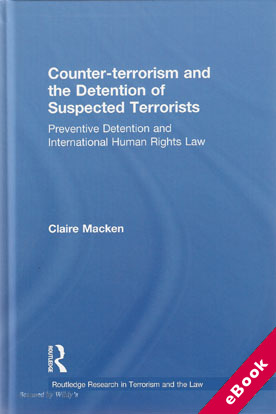
In a regional, national and global response to terrorism, the emphasis necessarily lies on preventing the next terrorist act. Yet, with prevention comes prediction: the need to identify and detain those considered likely to engage in a terrorist act in the future.
The detention of ‘suspected terrorists’ is intended, therefore, to thwart a potential terrorist act recognising that retrospective action is of no consequence given the severity of terrorist crime. Although preventative steps against those reasonably suspected to have an intention to commit a terrorist act is sound counter-terrorism policy, a law allowing arbitrary arrest and detention is not.
A State must carefully enact anti-terrorism laws to ensure that preventative detention does not wrongly accuse and grossly slander an innocent person, nor allow a terrorist to escape justice and walk free to continue their plans.
This book analyses preventative confinement in three models of counter-terrorism policy within the context of international human rights law: an ‘intelligence’ model of counter-terrorism which advocates preventative detention orders; a ‘war’ model which allows for even stricter executive detention orders; and a ‘criminal justice’ model, where pre-charge detention will often be the measure for confinement of suspected terrorists.
Counter-terrorism and the Detention of Suspected Terrorists argues that the way forward for Governments in counter-terrorism policy, from an international human rights law perspective, is a suggested model of pre-charge detention. The proposed model law recognises the exigencies of terrorist crime, but still maintains a sufficient threshold for appropriate detention.
The book is written from a global counter-terrorism perspective drawing on cases and practice from different jurisdictions including the US, the UK and Australia, as well as jurisprudence from the ECHR.










