
The eBooks we sell are sold as a single-user licence and are intended for the end user only.
The sale of some eBooks are restricted to certain countries. To alert you to such restrictions, please select the country of the billing address of your credit or debit card you wish to use for payment.
For further information see https://www.wildy.com/ebook-formats
Once the order is confirmed an e-mail will be sent to you to allow you to download the eBook. For UK purchases this will be automatic. For purchases outside the UK a member of staff will need to confirm the sale. (Staff are available to do this during normal business hours, Mon-Fri 8:30-17:00 UK time)
All eBooks are supplied firm sale and cannot be returned. If you believe there is a fault with your eBook then contact us on ebooks@wildy.com and we will help in resolving the issue. This does not affect your statutory rights.
Due to a technical issue some ebooks are not available to order.
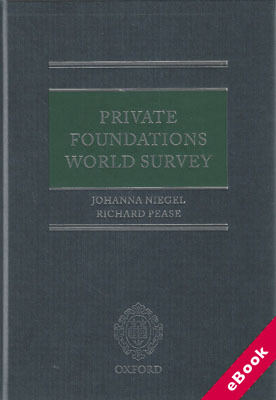
Rooted in the civil law systems of continental Europe, where foundations originally served mainly charitable purposes, the private foundation is an innovative development in common law jurisdictions.
More and more jursidictions are introducing private foundations as an alternative to trusts and practitioners are increasingly asked to advise clients on the intricacies of the developing law and the differences between jurisdictions.
Private Foundations World Survey is the first survey book to consider comprehensively private foundations law and practice in each of the key jurisdictions. With a unique questionnaire format and summary factsheet for easy reference, it examines all the fundamental aspects of setting up and maintaining a private foundation, with reference to relevant legislation and case law.
The two expert editors, along with a team of leading international practitioners, cover an exhaustive range of topics, including protectors, taxation, alternatives to private foundations, forced heirship, divorce, asset protection, and migration of private foundations as well as anti-money laundering and KYC requirements. Alongside 21 jurisdiction-specific chapters (which include jurisdictions where the law is still developing, as well as those with more established systems), the book contains general chapters on the uses of foundations and taxation issues in the UK and US.
It thus provides readers with all the information they need to confidently assess and advise on any aspect of private foundations law.










