The eBooks we sell are sold as a single-user licence and are intended for the end user only.
The sale of some eBooks are restricted to certain countries. To alert you to such restrictions, please select the country of the billing address of your credit or debit card you wish to use for payment.
For further information see https://www.wildy.com/ebook-formats
Once the order is confirmed an e-mail will be sent to you to allow you to download the eBook. For UK purchases this will be automatic. For purchases outside the UK a member of staff will need to confirm the sale. (Staff are available to do this during normal business hours, Mon-Fri 8:30-17:00 UK time)
All eBooks are supplied firm sale and cannot be returned. If you believe there is a fault with your eBook then contact us on ebooks@wildy.com and we will help in resolving the issue. This does not affect your statutory rights.
Due to a technical issue some ebooks are not available to order.
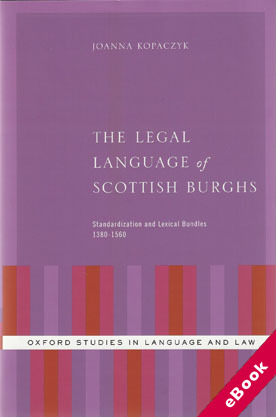
This book offers an innovative, corpus-driven approach to historical legal discourse. It is the first monograph to examine textual standardization patterns in legal and administrative texts on the basis of lexical bundles, drawing on a comprehensive corpus of medieval and early modern legal texts.
The book's focus is on legal language in Scotland, where law-with its own nomenclature and its own repertoire of discourse features-was shaped and marked by the concomitant standardizing of the vernacular language, Scots, a sister language to the English of the day.
Joanna Kopaczyk's study is based on a unique combination of two methodological frameworks: a rigorous corpus-driven data analysis and a pragmaphilological, context-sensitive qualitative interpretation of the findings.
Providing the reader with a rich socio-historical background of legal discourse in medieval and early modern Scottish burghs, Kopaczyk traces the links between orality, community, and law, which are reflected in discourse features and linguistic standardization of legal and administrative texts. In this context, the book also revisits important ingredients of legal language, such as binomials or performatives. Kopaczyk's study is grounded in the functional approach to language and pays particular attention to referential, interpersonal, and textual functions of lexical bundles in the texts.
It also establishes a connection between the structure and function of the recurrent patterns, and paves the way for the employment of new methodologies in historical discourse analysis.