The eBooks we sell are sold as a single-user licence and are intended for the end user only.
The sale of some eBooks are restricted to certain countries. To alert you to such restrictions, please select the country of the billing address of your credit or debit card you wish to use for payment.
For further information see https://www.wildy.com/ebook-formats
Once the order is confirmed an e-mail will be sent to you to allow you to download the eBook. For UK purchases this will be automatic. For purchases outside the UK a member of staff will need to confirm the sale. (Staff are available to do this during normal business hours, Mon-Fri 8:30-17:00 UK time)
All eBooks are supplied firm sale and cannot be returned. If you believe there is a fault with your eBook then contact us on ebooks@wildy.com and we will help in resolving the issue. This does not affect your statutory rights.
Due to a technical issue some ebooks are not available to order.
Winner of the 2022 SLS Peter Birks Prize for Outstanding Legal Scholarship
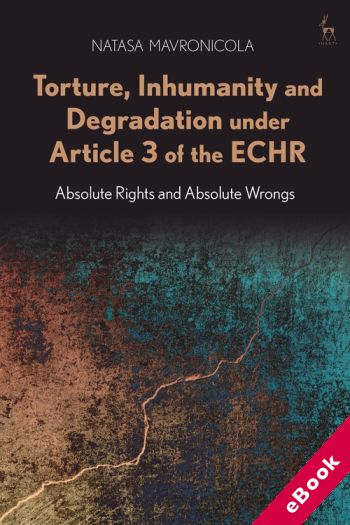
Human rights are the subject of enduring interest, engagement and controversy both in the academic and public domain. Absolute human rights provoke such interest and controversy even more intensely. Yet the interest and controversy triggered has not been equated with extensive and critically engaged legal scholarship on the meaning and implications of absoluteness as a characteristic of human rights, and how this informs the contours of the right enshrined in Article 3 of the ECHR. Article 3 prohibits torture, and inhuman or degrading treatment or punishment, with no exceptions or limitations.
The book will offer a persuasive theoretical framework for the delimitation of absolute rights in a way which remains faithful to their absolute nature. It aims to counter broad-brush accounts of the delimitation of absolute rights and provide an appropriately nuanced and intellectually honest account of the theoretical foundations, and the abstract and concrete challenges, of such delimitation.
In addition, the book will encompass a rigorous, methodical and theoretically engaged legal analysis of the character and scope of Article 3 of the ECHR, pursued in light of this framework. It will provide the tools for engaging in, and critically assessing, the delimitation of an absolute right with greater clarity and coherence, while also offering a much-needed defence for the continued recognition of the non-displaceable character of this fundamental - but contested - human right.