
The eBooks we sell are sold as a single-user licence and are intended for the end user only.
The sale of some eBooks are restricted to certain countries. To alert you to such restrictions, please select the country of the billing address of your credit or debit card you wish to use for payment.
For further information see https://www.wildy.com/ebook-formats
Once the order is confirmed an e-mail will be sent to you to allow you to download the eBook. For UK purchases this will be automatic. For purchases outside the UK a member of staff will need to confirm the sale. (Staff are available to do this during normal business hours, Mon-Fri 8:30-17:00 UK time)
All eBooks are supplied firm sale and cannot be returned. If you believe there is a fault with your eBook then contact us on ebooks@wildy.com and we will help in resolving the issue. This does not affect your statutory rights.
Due to a technical issue some ebooks are not available to order.
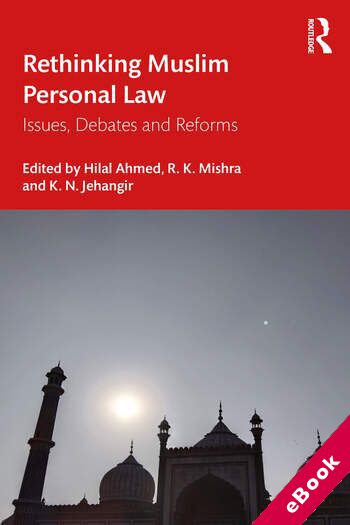
This volume critically analyses Muslim Personal Law (MPL) in India and offers an alternative perspective to look at MPL and the Uniform Civil Code (UCC) debate. Tracing the historical origins of this legal mechanism and its subsequent political manifestations, it highlights the complex nature of MPL as a sociological phenomenon, driven by context-specific social norms and cultural values. With expert contributions, it discusses wide-ranging themes and issues including MPL reforms and human rights; decoding of UCC in India; the contentious Triple Talaq bill and MPL; the Shah Bano case; Sharia (Islamic jurisprudence) in postcolonial India; women’s equality and family laws; and MPL in the media discourse in India. The volume highlights that although MPL is inextricably linked to Sharia, it does not necessarily determine the everyday customs and local practices of Muslim communities in India.
This topical book will greatly interest scholars and researchers of law and jurisprudence, political studies, Islamic studies, Muslim Personal Law, history, multiculturalism, South Asian studies, sociology of religion, sociology of law and family law. It will also be useful to practitioners, policymakers, law professionals and journalists.










