
The eBooks we sell are sold as a single-user licence and are intended for the end user only.
The sale of some eBooks are restricted to certain countries. To alert you to such restrictions, please select the country of the billing address of your credit or debit card you wish to use for payment.
For further information see https://www.wildy.com/ebook-formats
Once the order is confirmed an e-mail will be sent to you to allow you to download the eBook. For UK purchases this will be automatic. For purchases outside the UK a member of staff will need to confirm the sale. (Staff are available to do this during normal business hours, Mon-Fri 8:30-17:00 UK time)
All eBooks are supplied firm sale and cannot be returned. If you believe there is a fault with your eBook then contact us on ebooks@wildy.com and we will help in resolving the issue. This does not affect your statutory rights.
Due to a technical issue some ebooks are not available to order.
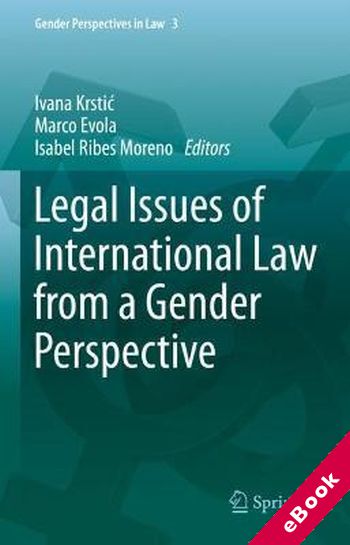
This book offers a new perspective on international law, which was, for centuries, male-dominant and gender-blind. However, this gender blindness has led to many injustices, the failure to recognize certain rights, and to impunity for serious crimes. The book examines the development of gender perspectives in various branches of international law, while also discussing and explaining certain universal standards. However, particular attention is paid to the European human rights system.
Accordingly, the book provides detailed explanations of the EU's external policies in relation to sex, sexual orientation, and gender identity. Also, there is a special focus on the relevant jurisprudence of the European Court of Human Rights in relation to gender and sexual orientation, female reproduction, and sexuality. The authors explain not only the importance of an adequate legal framework for combating gender inequality but also the detrimental effects of deeply rooted gender stereotypes and prejudices. Subsequently, the development of particular branches is presented, such as a gender-sensitive approach to the prevention of war crimes, gender perspectives in refugee law, and the evolution of gender-sensitive environmental law. In addition, the problematic situation of discrimination in the workplace is addressed from various perspectives. Many discussions, especially among EU member states, are reserved for the issue of women's participation in managerial boards, while the growing awareness of gender equality in international trade agreements represents another interesting topic. Lastly, the book offers a historical perspective on the development of international law in the interwar period, with a particular focus on the situation in Yugoslavia.
The book critically reconsiders the dominant molds of legal knowledge and presents innovative gender-sensitive and gender-competent insights on a variety of issues in international law, in order to introduce readers to new research topics relevant to gender equality and to stimulate the development of an international legal and institutional framework for achieving greater gender equality in practice. The collection of essays presented here will be of interest to all those working in the field of international law, as well as students and academics looking to broaden and deepen their research on a range of issues in international law from gender perspectives.










