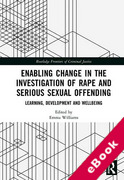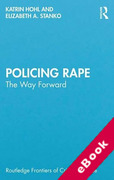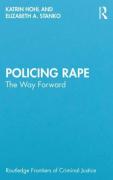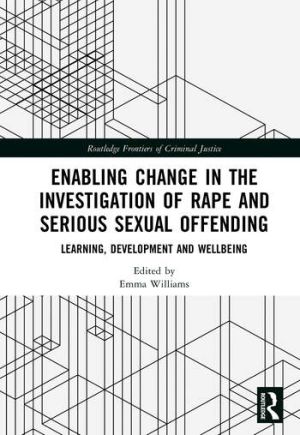
Operation Soteria—a major Home Office-funded initiative—examined how police investigate rape and serious sexual offences. This book focuses on a critical but often overlooked aspect of that project: the role of learning, development, and officer wellbeing in these challenging investigations.
The book challenges a widespread assumption: that more training and continuous professional development will fix the persistent failures in rape investigation. The research reveals something more troubling. The way police training is currently designed and delivered isn't solving the deep-rooted problems, in fact it has become part of the problem itself. Organisations retreat into training programmes as a comfortable response that creates an illusion of progress to an external audience, whilst the underlying cultures and structures that produce failures remain unchanged and unchallenged.
For students, this book offers fresh perspectives on organisational justice and change theories in action. You'll see how organisations can fail to support their own people even when they appear to be taking positive steps, and understand why genuine transformation requires confronting uncomfortable truths rather than deferring difficult conversations.
For practitioners and leaders, this is about moving beyond performative solutions. Officers investigating these crimes need real empowerment and support, not just training courses whose learning is neither valued nor embedded. We examine how the current approach affects officer welfare, shapes demand management, impacts victim services, and ultimately undermines organisational health. Most importantly, we explore how policing organisations can achieve genuine transformational change by addressing core systemic issues.
The book provides practical, evidence-based tools for demand modelling, strategic change planning, and assessing officer learning—all grounded on rigorous theoretical foundations. The aim is to help prevent the incremental build-up of burnout whilst building investigation capacity that serves both officers and victims effectively.
This collection speaks to police professionals, criminal justice practitioners, policymakers, and anyone seeking to understand why meaningful change in this critical area of policing remains so elusive—and what we can actually do about it.