Wildy Logo
(020) 7242 5778
enquiries@wildy.com

Book of the Month

Cover of Privacy as Property

Privacy as Property

Price: £95.00

Advocacy: A Practical
Guide 2nd ed


 Peter Lyons, Chris Taylor


Welcome to Wildys

Watch


Judicial Cooperation in Commercial Litigation 3rd ed (The British Cross-Border Financial Centre World)


 Ian Kawaley, David Doyle, Shade Subair Williams


Offers for Newly Called Barristers & Students

Special Discounts for Newly Called & Students

Read More ...


Secondhand & Out of Print

Browse Secondhand Online

Read More...


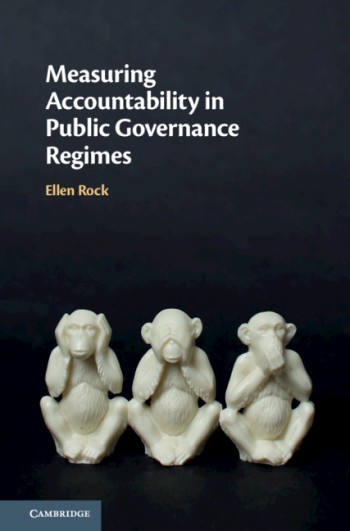
Measuring Accountability in Public Governance Regimes


ISBN13: 9781108814126
Published: August 2022
Publisher: Cambridge University Press
Country of Publication: UK
Format: Paperback (Hardback 2020)
Price: £25.00
Hardback edition , ISBN13 9781108840484


Despatched in 6 to 8 days.

Government accountability is generally accepted to be an essential feature of modern democratic society; while others might turn a blind eye to corruption and wrongdoing, those who value accountability would instead shine a bright light on it. In this context, it is common to hear claims of accountability 'deficit' (a particular mechanism or area is lacking in accountability) and 'overload' (a particular mechanism or area over-delivers on accountability). Despite the frequency of references to these concepts, their precise content remains undeveloped. This book offers an explanation, as well as a framework for future exploration, of these concepts. It highlights the difficulty of defining a benchmark that might be used to measure the amount of accountability in a particular situation, and also the challenge of mapping out accountability mechanisms as a system. While difficult, if accountability is indeed a foundational concept underpinning our system of government, there is merit in meeting these challenges head-on.


  • Provides an easy entry point for readers new to the accountability literature to come to grips with current debates and theories without the need for specialised disciplinary knowledge
  • Highlights for readers the gap in the existing accountability literature and offers a framework that can be built on in future work in this area
  • Provides interesting real-life examples of the potential operation of an accountability deficit and overload framework

Subjects:
Constitutional and Administrative Law, Jurisprudence
Contents:
Introduction
Part I. Accountability Deficits and Overloads
1. Defining accountability
2. Too little or too much of a good thing?
Part II. Benchmark of Accountability
3. Five rationales for accountability
4. Who should be held accountable?
5. To whom should they be accountable?
6. For what should they be accountable?
7. How should they be held accountable?
8. Defining and deploying a benchmark of accountability
Part III. The Complexity of Accountability Systems
9. Features in balance
10. Relationship dynamics in the system
11. Mapping out a system in practice Conclusion
Bibliography
Index.