The eBooks we sell are sold as a single-user licence and are intended for the end user only.
The sale of some eBooks are restricted to certain countries. To alert you to such restrictions, please select the country of the billing address of your credit or debit card you wish to use for payment.
For further information see https://www.wildy.com/ebook-formats
Once the order is confirmed an e-mail will be sent to you to allow you to download the eBook. For UK purchases this will be automatic. For purchases outside the UK a member of staff will need to confirm the sale. (Staff are available to do this during normal business hours, Mon-Fri 8:30-17:00 UK time)
All eBooks are supplied firm sale and cannot be returned. If you believe there is a fault with your eBook then contact us on ebooks@wildy.com and we will help in resolving the issue. This does not affect your statutory rights.
Due to a technical issue some ebooks are not available to order.
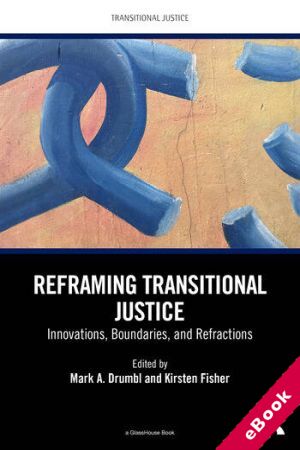
This book challenges the simplicity, predestination, and self-evident nature of the contemporary narratives of transitional justice.
Transitional justice is the field of study that examines how states should reckon with massive human rights abuses. The book upends these assumptive narratives on three crucial fronts. The first front is that of innovations. Here, the book questions the ability of transitional justice to deliver tangible successes in an era of rapid and overwhelming technological change and contestation over what constitutes human memory, communicative dialogue, and reliable evidence. The second front involves boundaries. Here the book confronts the professed superpower of transitional justice to do more and more, in an endless concatenation of additives. While there is cause for optimism, this book also suggests that transitional justice remains awkward in how it copes with the existential pressures of environmental, health, and cultural crises. On its third front, refractions, this book identifies how transitional justice addresses racism, misogyny, and democratic backsliding. Throughout, the book asks readers to imagine where the field and practice of transitional justice could go from here – what new innovations are required, what boundaries must be stretched or retrenched, and what perspectives need to be considered due to new ways of seeing current and past atrocities.
Accordingly, this book will be of considerable interest to academics, practitioners working on post-conflict reconstruction, ranging from undergraduate to post-doctoral studies in the areas of law, politics, cultural property, criminology, human rights, international relations, and technology studies.