The eBooks we sell are sold as a single-user licence and are intended for the end user only.
The sale of some eBooks are restricted to certain countries. To alert you to such restrictions, please select the country of the billing address of your credit or debit card you wish to use for payment.
For further information see https://www.wildy.com/ebook-formats
Once the order is confirmed an e-mail will be sent to you to allow you to download the eBook. For UK purchases this will be automatic. For purchases outside the UK a member of staff will need to confirm the sale. (Staff are available to do this during normal business hours, Mon-Fri 8:30-17:00 UK time)
All eBooks are supplied firm sale and cannot be returned. If you believe there is a fault with your eBook then contact us on ebooks@wildy.com and we will help in resolving the issue. This does not affect your statutory rights.
Due to a technical issue some ebooks are not available to order.
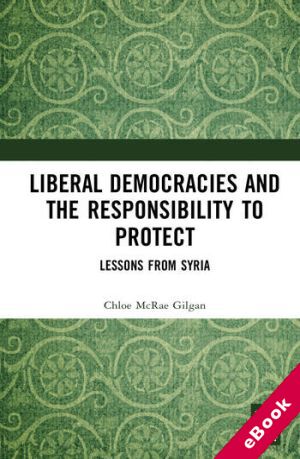
This book critically examines how the international norm of the Responsibility to Protect has been effectively limited by its interpretation by liberal states.
Under the Responsibility to Protect, states agree to use ‘diplomatic, humanitarian and other peaceful means’ to help protect populations – often refugees – from mass atrocities when the state is ‘manifestly failing’ to do so. Through an analysis of official discourse, as well as interviews with government officials and civil society representatives, this book examines how the Responsibility to Protect articulated by the UK and US governments was understood in the case of Syria. As the book demonstrates, the aspirations relied upon in the advocacy of the Responsibility to Protect are in constant tension with states’ conceptual understandings and practice of this norm. As the Syrian case indicates – and in a way that the book maintains as more generally representative – the Responsibility to Protect is routinely interpreted and modified in ways that effectively limit both its meaning and its implementation. In conclusion, the book’s analysis contributes to realising a more coherent government policy on atrocity prevention and response that does not undermine humanitarian protection and international consensus on the Responsibility to Protect.
This book will appeal to scholars, research students, practitioners, and policymakers in the areas of international law, human rights, international relations, peace and conflict studies, and refugee studies.