The eBooks we sell are sold as a single-user licence and are intended for the end user only.
The sale of some eBooks are restricted to certain countries. To alert you to such restrictions, please select the country of the billing address of your credit or debit card you wish to use for payment.
For further information see https://www.wildy.com/ebook-formats
Once the order is confirmed an e-mail will be sent to you to allow you to download the eBook. For UK purchases this will be automatic. For purchases outside the UK a member of staff will need to confirm the sale. (Staff are available to do this during normal business hours, Mon-Fri 8:30-17:00 UK time)
All eBooks are supplied firm sale and cannot be returned. If you believe there is a fault with your eBook then contact us on ebooks@wildy.com and we will help in resolving the issue. This does not affect your statutory rights.
Due to a technical issue some ebooks are not available to order.
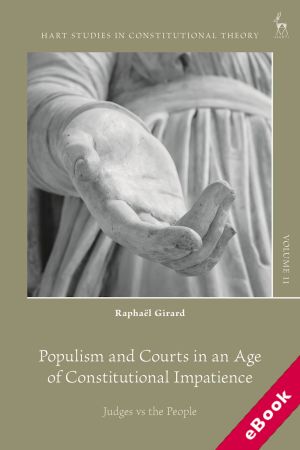
This book addresses one of the most pressing issues of our time: the rise of populism and its implications, particularly for courts and other legal institutions. It questions and ultimately challenges the prevailing view in comparative constitutional law that courts can act as bulwarks against authoritarian, self-aggrandising populists in power. In doing so, it offers both a novel theoretical framework and a fresh contextual inquiry.
Theoretically, the book uses the lens of spatiotemporality – the conjunction of space and time – to analyse populism as a constitutional project. It argues that contemporary populism is marked by constitutional impatience: a drive for temporal efficiency and spatial proximity that reshapes and reconfigures law's institutional and normative order.
Contextually, the book focuses primarily on one key institution of liberal constitutional democracy: the judiciary. It offers a contextual analysis of three case studies: Armenia, Ecuador and the United Kingdom. In doing so, it not only highlights populism's reach beyond established democracies but also brings fresh insights from understudied jurisdictions at the periphery or in the Global South.
Overall, the book suggests that populism's relationship with constitutionalism is complex and context-dependent. Instead of yielding uniform outcomes, it produces divergent tensions and impacts, thereby challenging assumptions about both the institutional role of courts and the nature of constitutionalism itself.












Due to a technical issue some ebooks are not available to order.


Due to a technical issue some ebooks are not available to order.


Due to a technical issue some ebooks are not available to order.


Due to a technical issue some ebooks are not available to order.



Due to a technical issue some ebooks are not available to order.
Due to a technical issue some ebooks are not available to order.