The eBooks we sell are sold as a single-user licence and are intended for the end user only.
The sale of some eBooks are restricted to certain countries. To alert you to such restrictions, please select the country of the billing address of your credit or debit card you wish to use for payment.
For further information see https://www.wildy.com/ebook-formats
Once the order is confirmed an e-mail will be sent to you to allow you to download the eBook. For UK purchases this will be automatic. For purchases outside the UK a member of staff will need to confirm the sale. (Staff are available to do this during normal business hours, Mon-Fri 8:30-17:00 UK time)
All eBooks are supplied firm sale and cannot be returned. If you believe there is a fault with your eBook then contact us on ebooks@wildy.com and we will help in resolving the issue. This does not affect your statutory rights.
Due to a technical issue some ebooks are not available to order.
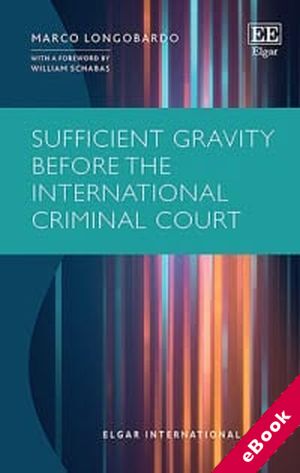
Challenging the view that sufficient gravity is mainly a tool for prosecutorial discretion, this book reconstructs the interpretation of this criterion and argues for its assessment in objective and legally grounded terms. Marco Longobardo expertly examines case law and prosecutorial practice pertaining to situations and cases under Article 17(1)(d) of the Rome Statute of the ICC to inform his criticism of the assessment of sufficient gravity.
The book reviews the assessment of sufficient gravity to evaluate the decisions of the Office of the Prosecutor (OTP) and case law of the Chambers. Chapters explore case studies such as the Lubanga and Ntaganda arrest warrants and the boarding of the Mavi Marmara. Combining jurisprudential and international law perspectives, Longobardo analyses the rules of treaty interpretation and applies them as a methodological framework to assess sufficient gravity.
Sufficient Gravity before the International Criminal Court is a crucial resource for scholars and students in international criminal law and justice and public international law. This book’s scrutinisation of sufficient gravity provides guidance to ICC organs and parties and contributes to the reinforcement of the ICC project. It is also beneficial for practitioners and NGOs working on issues pertaining to sufficient gravity before the ICC.