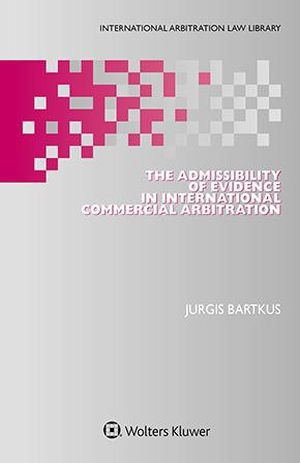
The Admissibility of Evidence in International Commercial Arbitration is an innovative book that provides a penetrating analysis of the underlying function and purpose of admissibility rules and guides practitioners to more predictable and better-reasoned decisions on whether to admit or exclude evidence in international commercial arbitration (ICA) proceedings and how such evidence should be treated. In ICA practice, the rules on admissibility of evidence are often framed not as fixed legal rules but as discretion-conferring provisions (the so-called liberal approach) – a stratagem which tends to generate legal uncertainty, contradictory case law, subjective decision making, and inefficiency.
What’s in this book:
Drawing on the principal sources governing the taking of evidence in arbitration – including the UNCITRAL Model Law, institutional arbitration rules, the IBA Rules on the Taking of Evidence, and the New York Convention – the author assesses the whole status quo of admissibility of evidence in ICA, focusing on such aspects as the following:
The analysis clearly shows how the ‘liberal’ approach has prevented a clear understanding both of specific rules on the admissibility of evidence set out in the sources and of the importance of these rules in arbitration proceedings. Accordingly, the author puts forward concrete reform proposals, centred on amending a soft law instrument through balancing tests built on an exhaustive, predetermined list of criteria, which would curb the problems of discretion while preserving the flexibility of arbitration.
How this will help you:
The book serves a broad professional readership – arbitrators, arbitration counsel, in-house lawyers, arbitral institutions, and academics – by bridging the gap between evidence theory and arbitral practice. It will equip arbitrators and counsel to frame and respond to admissibility objections with greater rigour, help arbitration users plan their evidentiary strategy, and offer scholars and law reformers a critical framework and concrete proposals for improving the legal certainty, consistency, and efficiency of evidentiary decision making in arbitration.