The eBooks we sell are sold as a single-user licence and are intended for the end user only.
The sale of some eBooks are restricted to certain countries. To alert you to such restrictions, please select the country of the billing address of your credit or debit card you wish to use for payment.
For further information see https://www.wildy.com/ebook-formats
Once the order is confirmed an e-mail will be sent to you to allow you to download the eBook. For UK purchases this will be automatic. For purchases outside the UK a member of staff will need to confirm the sale. (Staff are available to do this during normal business hours, Mon-Fri 8:30-17:00 UK time)
All eBooks are supplied firm sale and cannot be returned. If you believe there is a fault with your eBook then contact us on ebooks@wildy.com and we will help in resolving the issue. This does not affect your statutory rights.
Due to a technical issue some ebooks are not available to order.
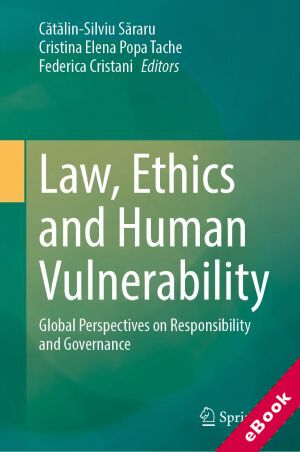
This volume brings together the revised and peer reviewed scientific contributions presented at the 5th Conference on Comparative and International Law (27 June 2025), jointly organized by the Law Center of the Catholic University of Petrópolis (Brazil) and the Society of Juridical and Administrative Sciences.
The book explores the intersections between law, ethics, and human vulnerability through a transnational and comparative lens, addressing some of the most pressing challenges of our time: technological risks, equality and responsibility in evolving legal frameworks, and the pursuit of justice in the fields of human rights and international criminal law.
The volume is structured into three thematic parts: (1) Technology, Risks and Global Governance – examining how global administrative law, artificial intelligence, and medical innovations such as xenotransplantation generate both opportunities and existential risks, thereby calling for renewed forms of international regulation and ethical responsibility. (2) Responsibility, Equality and Comparative Legal Perspectives – engaging with philosophical and legal perspectives on responsibility, analysing authority and social hierarchies within civil law traditions, and evaluating the principle of equal opportunities between women and men in electoral law from comparative angles. (3) Justice, Human Rights and International Criminal Law – addressing forgotten or ongoing struggles for justice, the contested authority of the International Criminal Court, and the strengths and limitations of climate change litigation as a mechanism for advancing environmental justice.
The central theme of the book is how legal and governance frameworks can address human vulnerability in a rapidly changing global context, where ethical dilemmas, technological disruptions, and structural inequalities converge. Its relevance lies in its ability to connect theoretical insights (legal philosophy, comparative analysis, ethics) with practical challenges (international justice, technological governance, gender equality), thereby offering both critical reflection and policy oriented perspectives.
The volume aims to contribute to addressing the tension between global responsibility and local governance by providing comparative knowledge and highlighting pathways toward more equitable and accountable systems of law and regulation. The target readership includes academics, researchers, PhD candidates, practitioners in international and comparative law, and policymakers interested in the evolving interplay of ethics, vulnerability, and governance in shaping law’s response to contemporary global challenges.