The eBooks we sell are sold as a single-user licence and are intended for the end user only.
The sale of some eBooks are restricted to certain countries. To alert you to such restrictions, please select the country of the billing address of your credit or debit card you wish to use for payment.
For further information see https://www.wildy.com/ebook-formats
Once the order is confirmed an e-mail will be sent to you to allow you to download the eBook. For UK purchases this will be automatic. For purchases outside the UK a member of staff will need to confirm the sale. (Staff are available to do this during normal business hours, Mon-Fri 8:30-17:00 UK time)
All eBooks are supplied firm sale and cannot be returned. If you believe there is a fault with your eBook then contact us on ebooks@wildy.com and we will help in resolving the issue. This does not affect your statutory rights.
Due to a technical issue some ebooks are not available to order.
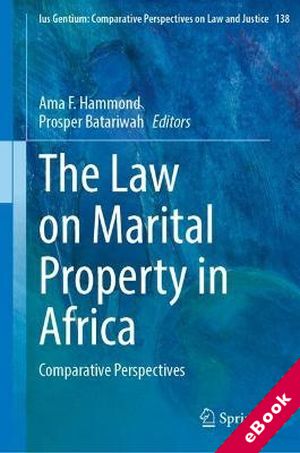
The book focuses on the ownership and distribution of marital property upon the dissolution of marriages in Africa. In each of the 16 African countries, the laws on the subject are drawn from different systems of law, whether customary, state law or religious law, and are enmeshed in a complex scheme of legal pluralism. The laws developed by the various internal systems of law have often been unfair, as women seem to have been discriminated against and have little by way of property rights, both in and out of marriages. Scholars researching African family law have conducted individual studies of marital property rights at the state level. Consequently, there is no comparative text that explains how laws in Africa regulate property rights in the context of marriage and divorce. This book seeks to fill this gap by highlighting shared themes such as spousal property classification, legal pluralism, marriage contracts, irregular unions, and human rights, and offering a comparative perspective on fairness and justice in marital property distribution.
The book defines marital property as understood in different legal contexts and evaluates the legal framework governing the rights that spouses have in marital property during the subsistence of the marriage and on divorce. The book also assesses the impact of international and domestic human rights law on each country's legal framework for the ownership and distribution of marital property upon divorce, and offers recommendations for improving these frameworks.