
The eBooks we sell are sold as a single-user licence and are intended for the end user only.
The sale of some eBooks are restricted to certain countries. To alert you to such restrictions, please select the country of the billing address of your credit or debit card you wish to use for payment.
For further information see https://www.wildy.com/ebook-formats
Once the order is confirmed an e-mail will be sent to you to allow you to download the eBook. For UK purchases this will be automatic. For purchases outside the UK a member of staff will need to confirm the sale. (Staff are available to do this during normal business hours, Mon-Fri 8:30-17:00 UK time)
All eBooks are supplied firm sale and cannot be returned. If you believe there is a fault with your eBook then contact us on ebooks@wildy.com and we will help in resolving the issue. This does not affect your statutory rights.
Due to a technical issue some ebooks are not available to order.
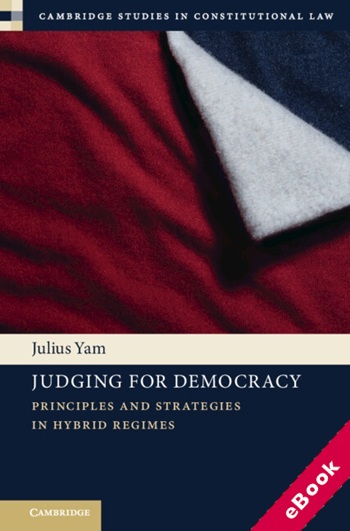
This book examines how constitutional courts can sustainably contribute to advancing democratic norms in hybrid regimes, i.e. regimes that are neither fully democratic nor fully authoritarian. Using a comparative approach analysing cases from across the globe, particularly from Hong Kong, Pakistan, and Uganda, Julius Yam makes the case that courts can assume a democracy-enhancing role in hybrid regimes. The book reveals the challenges faced by courts in performing such a role. It also proposes an adjudicative framework that systematically integrates principled judging with judicial strategy, and suggests non-adjudicative techniques that judges can adopt to reinforce democracy.
While theoretical in substance, this book is informed by empirical studies and draws on a wide range of disciplines, including law, political science, sociology, and psychology. The book will be a key resource to judges, academics, and practitioners who are interested in the study of democracy and courts. Its insights are particularly pertinent in an age of democratic backsliding and resurgence of authoritarianism.










