The eBooks we sell are sold as a single-user licence and are intended for the end user only.
The sale of some eBooks are restricted to certain countries. To alert you to such restrictions, please select the country of the billing address of your credit or debit card you wish to use for payment.
For further information see https://www.wildy.com/ebook-formats
Once the order is confirmed an e-mail will be sent to you to allow you to download the eBook. For UK purchases this will be automatic. For purchases outside the UK a member of staff will need to confirm the sale. (Staff are available to do this during normal business hours, Mon-Fri 8:30-17:00 UK time)
All eBooks are supplied firm sale and cannot be returned. If you believe there is a fault with your eBook then contact us on ebooks@wildy.com and we will help in resolving the issue. This does not affect your statutory rights.
Due to a technical issue some ebooks are not available to order.
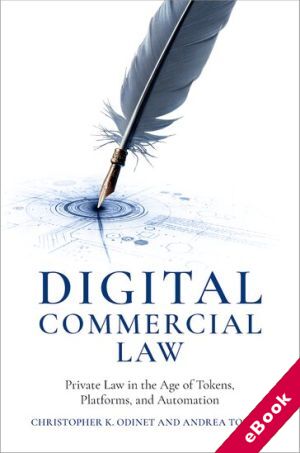
From Bitcoin and stablecoins to NFTs, digital assets recorded on blockchain networks have reshaped the commercial landscape. Yet despite this transformation, their legal treatment has been dangerously skewed. While regulators and scholars have fixated on financial oversight, a crucial legal dimension has been neglected: private law.
Digital Commercial Law exposes two fundamental imbalances plaguing the digital asset ecosystem. First, the legal community's overwhelming emphasis on financial regulation has eclipsed the private law foundations governing ownership, transfer, custody, and collateralization. Second, when private law issues are considered, contractual arrangements are treated as all-controlling while property, bailment, secured transactions, and bankruptcy concepts are disregarded. Through doctrinal analysis and case studies, Odinet and Tosato illuminate how this disequilibrium leads to market dysfunction and systemic risk, while demonstrating how a balanced approach can restore stability.
Written by leading authorities on digital asset law, this groundbreaking book directly addresses these critical flaws by making a compelling case for restoring private law, in all its facets, to its central role in the digital economy.