The eBooks we sell are sold as a single-user licence and are intended for the end user only.
The sale of some eBooks are restricted to certain countries. To alert you to such restrictions, please select the country of the billing address of your credit or debit card you wish to use for payment.
For further information see https://www.wildy.com/ebook-formats
Once the order is confirmed an e-mail will be sent to you to allow you to download the eBook. For UK purchases this will be automatic. For purchases outside the UK a member of staff will need to confirm the sale. (Staff are available to do this during normal business hours, Mon-Fri 8:30-17:00 UK time)
All eBooks are supplied firm sale and cannot be returned. If you believe there is a fault with your eBook then contact us on ebooks@wildy.com and we will help in resolving the issue. This does not affect your statutory rights.
Due to a technical issue some ebooks are not available to order.
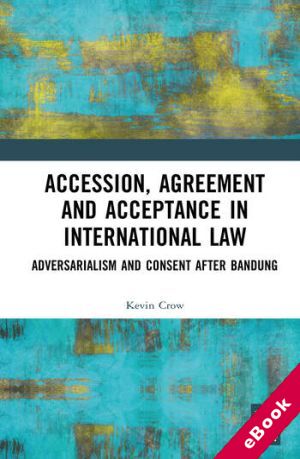
This book shows that State accession to an international legal text is understood differently in different parts of the world, and moreover, that many conventions in the practice of international law are justifiable because of the assumption that accession is agreement.
The dominant understanding of accession as agreement has its roots in European legal traditions, where the notion that a legal text can represent an ascertainable and static ‘meeting of the minds’ underpins the logic of adversarial procedures, declarative judgment, punitive sanctions, and concepts such as necessity. This book shows how the 1955 Bandung Conference articulated a largely neglected vision of accession as acceptance, rather than agreement – one much older than those used at the 1945 San Francisco Conference establishing the UN Charter, one much older than the 1948 Universal Declaration of Human Rights that became a mandatory precondition of moder statehood, and one from which perspective different legal concepts, such as non-intervention and consensus-based dispute settlement can be derived. Following the Bandungian idea of ‘accession as acceptance’ through subsequent decades of international law, the book chronicles the legacy of the acceptance-agreement disconnect in Third World engagements with international law. The book then argues that the consent as agreement assumption infuses the very process of adversarial judgment – a process almost indivisible from the practice of international law – with a self-sustaining imperial ideology. Finally, the book offers suggestions for procedural reform.
This book will appeal primarily to scholars interested in international adjudication, the history and theory of international law, Third World Approaches to International Law, as well as others with an interest in the lasting impact of colonialism on global institutions.