The eBooks we sell are sold as a single-user licence and are intended for the end user only.
The sale of some eBooks are restricted to certain countries. To alert you to such restrictions, please select the country of the billing address of your credit or debit card you wish to use for payment.
For further information see https://www.wildy.com/ebook-formats
Once the order is confirmed an e-mail will be sent to you to allow you to download the eBook. For UK purchases this will be automatic. For purchases outside the UK a member of staff will need to confirm the sale. (Staff are available to do this during normal business hours, Mon-Fri 8:30-17:00 UK time)
All eBooks are supplied firm sale and cannot be returned. If you believe there is a fault with your eBook then contact us on ebooks@wildy.com and we will help in resolving the issue. This does not affect your statutory rights.
Due to a technical issue some ebooks are not available to order.
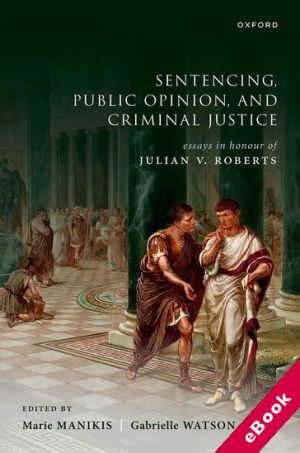
This volume celebrates the achievements of Julian V Roberts KC (Hon), Emeritus Professor of Criminology at the University of Oxford, over 40 years of scholarship. To mark his extraordinary influence on sentencing and criminal justice on the global stage, the contributors - a mix of international scholars and members of the judiciary - present a collection of themed essays in his honour.
Roberts is the leading academic authority on sentencing theory, policy, and practice in common law jurisdictions, and his work has made a landmark contribution to the analysis and development of sentencing worldwide. His work is innovative and inspired, known for identifying core challenges and defining research needs before they become central to criminal justice agendas. A distinguished group of authors engage in an interdisciplinary appreciation of Roberts' work in three distinct domains: foundations of sentencing theory, sentencing policy and penal practice, and public opinion and criminal justice.
Drawn from nine jurisdictions, the authors offer fresh insight into Roberts' past accomplishments as well as the future of the field that he continues to shape. Together, they demonstrate a collective commitment to advancing Roberts' lifelong project of normative, comparative, and empirical engagement with questions of crime and justice.