
The eBooks we sell are sold as a single-user licence and are intended for the end user only.
The sale of some eBooks are restricted to certain countries. To alert you to such restrictions, please select the country of the billing address of your credit or debit card you wish to use for payment.
For further information see https://www.wildy.com/ebook-formats
Once the order is confirmed an e-mail will be sent to you to allow you to download the eBook. For UK purchases this will be automatic. For purchases outside the UK a member of staff will need to confirm the sale. (Staff are available to do this during normal business hours, Mon-Fri 8:30-17:00 UK time)
All eBooks are supplied firm sale and cannot be returned. If you believe there is a fault with your eBook then contact us on ebooks@wildy.com and we will help in resolving the issue. This does not affect your statutory rights.
Ocean Law and Coastal Law have grown rapidly in the past three decades as specialty areas within natural resources law and environmental law.
The protection of oceans has received increased attention in the past decade because of the global overfishing crisis, widespread depletion of marine living resources (such as marine mammals and coral reefs), and oil pollution.
During this same period, climate change regulation has emerged as a focus of international environmental diplomacy, and has gained increased attention in the wake of disturbing and abrupt climate change related impacts throughout the world that have profound implications for ocean and coastal regulation and marine resources.
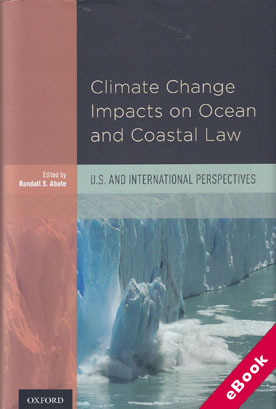
Climate Change Impacts on Ocean and Coastal Law effectively brings together the two worlds of climate change and ocean and coastal management. It raises important questions about whether and how ocean and coastal law will respond to the regulatory challenges that climate change presents to resources in the oceans and coasts of the U.S. and the world.
This comprehensive work assembles the insights of global experts from academia and major NGOs (e.g., Center for International Environmental Law, Ocean Conservancy, and Environmental Law Institute) to address regulatory challenges from the perspectives of U.S. law, foreign domestic law, and international law.










