
The eBooks we sell are sold as a single-user licence and are intended for the end user only.
The sale of some eBooks are restricted to certain countries. To alert you to such restrictions, please select the country of the billing address of your credit or debit card you wish to use for payment.
For further information see https://www.wildy.com/ebook-formats
Once the order is confirmed an e-mail will be sent to you to allow you to download the eBook. For UK purchases this will be automatic. For purchases outside the UK a member of staff will need to confirm the sale. (Staff are available to do this during normal business hours, Mon-Fri 8:30-17:00 UK time)
All eBooks are supplied firm sale and cannot be returned. If you believe there is a fault with your eBook then contact us on ebooks@wildy.com and we will help in resolving the issue. This does not affect your statutory rights.
Due to a technical issue some ebooks are not available to order.
International environmental agreements have increased exponentially within the last five decades. However, decisions on policies to address key issues such as biodiversity loss, climate change, ozone depletion, hazardous waste transport and numerous other planetary challenges require individual countries to adhere to international norms.
What have been the successes and failures in the environmental treaty-making arena? How has the role of civil society and scientific consensus contributed to this maturing process? Why have some treaties been more enforceable than others and which theories of international relations can further inform efforts in this regard? Addressing these questions with renewed emphasis on close case analysis makes this volume a timely and thorough postscript to the Rio-Plus 20 summit's celebrated invocation document, The Future We Want, towards sustainable development.
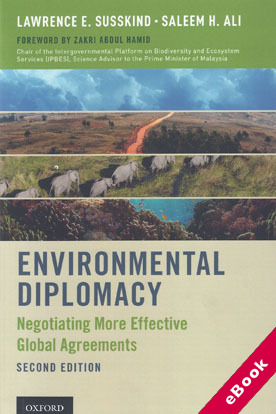
Environmental Diplomacy: Negotiating More Effective Global Agreements provides an accessible narrative on understanding the geopolitics of negotiating international environmental agreements and clear guidance on improving the current system.
In this book, authors Lawrence Susskind and Saleem Ali expertly observe international environmental negotiations to effectively inform the reader on the geopolitics of protecting our planet. This second edition offers an additional perspective from the Global South as well as providing a broader analysis of the role of science in environmental treaty-making. It provides a unique contribution as a panoramic analysis of the process of environmental treaty-making.










